
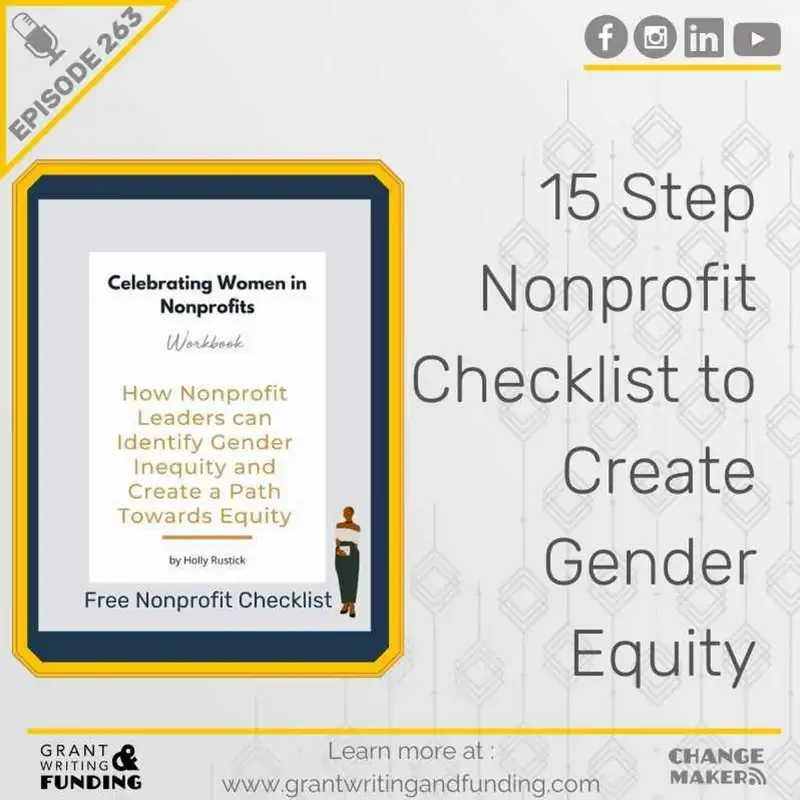
Don’t just assume that gender inequity doesn’t exist in your nonprofit organization.
Even though women represent 75 percent of people working in nonprofit organizations in the United States, we know that there are leadership positions and pay gaps rampant in nonprofit organizations.
However, it’s not all doom and gloom either. There are ways to create gender equity for your nonprofit organization.
Here are 15-steps for your nonprofit to create a culture of gender equity.
Nonprofit Checklist Step #1: Conduct a Recruitment Self-Audit for Nonprofit Gender Equity in Your Nonprofit
It is important to understand what your recruitment process is when seeking candidates for positions at your nonprofit organization.
When writing position descriptions do you seek employee input and develop consensus for position descriptions? This can be essential to having an internal spotlight on getting someone to fill real gaps.
An important note is to NOT put everything and anything into a job description. I have seen this too often be a ‘wish list’ rather than an actual job description. If you fill your job descriptions with too many wishes, chances are you will not get very many qualified candidates.
And chances are you will get more men applying than women, even if the men aren’t as qualified. Women don’t apply for jobs like men: Studies show that men often apply for jobs when they only meet 60% of qualifications, but women only apply if they meet 100% of them.
One other important consideration is, “Are you requiring previous salaries?” This can automatically give men a higher wage, as historically and currently, there is an average pay gap between men and women.
By asking for previous salaries, you are essentially continuing the gender and marginalized pay gap pattern.
For the full free Nonprofit Checklist for Gender Equity, click here.
Nonprofit Checklist Step #2: Evaluate Your Compensation System for Internal Equity in Your Nonprofit
Evaluating your internal compensation system is just as important as hiring new folks.
Questions for your Nonprofit to Consider:
- Do you have a method to determine salaries and benefits?
- Do you have a consistent job evaluation system?
- Can workers negotiate their pay? (women vs. men) This may be flawed as historically women do not negotiate as often as men, even if they are more qualified for promotions compared to men.
- How long do men, women and minorities stay within job grades or scores before moving up?
For the full free Nonprofit Checklist for Gender Equity, click here.
Nonprofit Checklist Step #3: Evaluate Your Compensation System for Industry Competitiveness in Your Nonprofit
It’s vital to evaluate your nonprofit’s compensation system compared to industry standards.
Questions for your Nonprofit to Consider:
- Does your nonprofit have a method to determine the market rate for any given job?
- Can you be confident that men are not being compensated at or above market rates while women and minority workers are compensated at or below market rates?
- Do you consider whether the market has undercompensated certain occupations or professions before adjustments?
For the full free Nonprofit Checklist for Gender Equity, click here.
Nonprofit Checklist Step #4: Assess How Raises are Awarded in Your Nonprofit
Let’s get into pay raises at your nonprofit.
Questions for your Nonprofit to Consider:
- Do men, women and minorities receive consistent raises based on similar performance standards?
- Are all workers with outstanding evaluations awarded the same percentage increases? If not, what are the reasons for the difference?
- Are men, women and minorities with similar levels of performance awarded bonuses on a consistent basis?
- Do they receive bonuses of similar monetary values?
For the full free Nonprofit Checklist for Gender Equity, click here.
Nonprofit Checklist Step #5: Evaluate Employee Training, Development and Promotion Opportunities in Your Nonprofit
The thing is, you may discover that your nonprofit does in fact have gender pay gaps, but you aren’t sure how it got that way. One specific trajectory is for certain employees to be given (or seek) certain training or development opportunities, and then these slots are filled up before other employees are approached. That can lead directly (and very validly) to a promotion.
But here’s the thing. Men, on average, are more vocal to ask about employee training and opportunities. Women, on average, have more unpaid requirements such as picking up the kids after school, so may not have the extra time to stay at work late for additional employee training.
To change the culture of your nonprofit it is important to think outside the box for ways to seek more women and diverse inclusion for employee training opportunities. Classes taken online is one example of how you can narrow the gap.
Questions for your Nonprofit to Consider:
How are workers selected for participation in training opportunities or special projects that lead to advancement?
Are there differences by race or gender? If so, what can be done to widen the pool to reflect equal opportunity?
For the full free Nonprofit Checklist for Gender Equity, click here.
Nonprofit Checklist Step #6: Ensure Pay Transparency Practices in Your Nonprofit
Ensuring that your nonprofit practices transparency is a doozy. One of the quickest ways to create more gender equity within your nonprofit organization is to post salaries.
Yep, you heard that right. Why? Because this keeps everyone accountable. One of the most gender equitable pay ranges of any industry in the United States is the U.S. Federal Government.
Why? Because they have to post their salary ranges. This is the quickest and most effective ways to create more gender equity.
Questions for your Nonprofit to Consider:
- Do you regularly post job openings and salary ranges within the workplace?
- Do you publish your compensations publicly?
For the full free Nonprofit Checklist for Gender Equity, click here.
Nonprofit Checklist Step #7: Provide Benefits that work to Sustain Gender Equity in Your Nonprofit
Many workers during the Great Resignation and the Quiet Quitting movements are not only seeking certain pay scales. They are looking even closer at the benefits associated with working within a nonprofit organization.
Questions for your Nonprofit to Consider:
- Do you provide adequate paid maternity leave and paternity leave? (are you following the law and surpassing it?)
- Do you account for the unpaid labor and caregiving responsibilities that women incur?
For the full free Nonprofit Checklist for Gender Equity, click here.
Nonprofit Checklist Step #8: Assess Your Facility to Account for 75% of Your Population at Your Nonprofit
Yes, women do makeup 75 percent (on average) of staff at a nonprofit organization. But do you consider women’s bodies in your facility?
Questions for your Nonprofit to Consider:
- Are temperatures (heat/air conditioner) set for women or men’s bodies?
- Do you have glass stairs that easily show up women’s dresses?
- Are there ample cabinets that women can reach?
- Are your doors super difficult to close?
- Do you include more square footage for women’s bathrooms (since there are more women?)?
- Do you have pregnancy parking?
For the full free Nonprofit Checklist for Gender Equity, click here.
Nonprofit Checklist Step #9: Does Your Nonprofit Have Gender Equity Buy-In, Training, and Centralized Groups?
Does your nonprofit’s board of directors contribute to gender equity within your organization? This is important to have policies that surround gender equity at its core, such as anti-harassment policies.
Questions for your Nonprofit to Consider:
- Do you include gender equity policy buy-in from the executive director and the board?
- Do you provide gender equity training from experts?
- Do you have a cross-department gender group (i.e., people from all job classifications)?
For the full free Nonprofit Checklist for Gender Equity, click here.
Nonprofit Checklist Step #10: Conduct Focus Groups and Surveys at Your Nonprofit
It is important to create a culture of gender equity by involving your current staff and constituents. Gathering information about the way that they perceive and experience gender equity can help you understand the changes needed to be made.
Question for your Nonprofit to Consider:
- Do you conduct Focus Groups and Surveys? (do you include employees, volunteers, constituents, board members, funders)?
For the full free Nonprofit Checklist for Gender Equity, click here.
Nonprofit Checklist Step #11: Integrate Gender Equity into Your Budgets for Your Nonprofit Programs
Budgets at your nonprofit should include adequate funding to support gender equality goals and programming. You can include personnel, capacity building, professional development and so much more.
Question for your Nonprofit to Consider:
- Does your nonprofit include gender equity within your budget or grant programs?
For the full free Nonprofit Checklist for Gender Equity, click here.
Nonprofit Checklist Step #12: Ensure there are Accountability Measures for Growing Gender Equity Within Your Nonprofit
Growing gender equity is not an overnight ordeal. Even if you gave everyone working with you the same wage, there are still other gaps (i.e. access to training, promotions, facility access, getting hired, etc.) that we have discovered.
It is important to include a process to overcome this inequity and to ensure that full equity is moving forward.
Questions for your Nonprofit to Consider:
- Does your nonprofit include measures that restore imbalances?
- Are there safe spaces for women to talk?
- Does your nonprofit build training to support men as allies
- Is there equitable power within your nonprofit for women? I.e., are more men in leadership positions?
For the full free Nonprofit Checklist for Gender Equity, click here.
Nonprofit Checklist Step #13: Include Gender Equity in Your Nonprofit’s Advertising & Communication
Many nonprofits may not realize that their graphics on their website or in their social media posts are primarily white men. The reason for this? Well, you can go to any stock photo place and a majority of pictures are of white men.
Questions for your Nonprofit to Consider:
- What types of images and branding are you using for your nonprofit?
- Are you client shaming to ‘tug hearts’ for funding?
For the full free Nonprofit Checklist for Gender Equity, click here.
Nonprofit Checklist Step #14: Does Your Nonprofit Ensure Supplier Diversity?
This is one that your nonprofit may not be at the top of your mind. However, if your intention is to create more of a gender equity culture, also consider buying your supplies, renting your office, or doing business with more women-owned businesses.
Questions for your Nonprofit to Consider:
- Where are you getting your supplies?
- Are you supporting women-owned, Black-owned, Latino-owned, and other marginalized businesses?
For the full free Nonprofit Checklist for Gender Equity, click here.
Nonprofit Checklist Step #15: Ensure Your Funders & Partners Support Gender Equity
It’s not just about how your nonprofit manages money, but it is also about where the money comes from. And it is equally important to understand the values of your partners.
Questions for your Nonprofit to Consider:
- Do your funders and partners support equity?
- Do your funders and partners know about equity (are you taking the time to educate them on where your dollars go for equity and what your overall social justice movement is?)
- Do you advocate with partners?
For the full free Nonprofit Checklist for Gender Equity, click here.
Links Associate with this Episode:
- Why are Female Freelance Grant Writers Working for Free?
- Why Female Grant Writers Struggle with Pricing & Rates
- Grant Writer Pricing Survey: Why Grant Professionals Don’t Feel Valued
- Women in Nonprofits: Does Representation Equate to Leadership & Pay Equity?
ABOUT HOLLY RUSTICK
Grant Writing & Funding (GWF) has a Global Movement to Secure $1 Billion in Grant Funding for Good and $30 Million in Grant Writing Businesses by 2030. Holly Rustick, CEO of GWF, is leading the movement; a world-renowned grant writer with 20+ years of experience, bestselling author, and business coach for new and seasoned grant writers to replace their full-time income writing grants part-time from home through her signature programs: the Freelance Grant Writer Academy and the Grant Professional Mentorship.
Rustick is the host of the top grant writing podcast “Grant Writing & Funding” and the author of the Bestselling book, The Beginner’s Guide to Grant Writing. With an MA in International Political Economy, past-president of the Guam Women’s Chamber of Commerce, serving on numerous boards of directors, Holly is also an unapologetic feminist. She lives on the island of Guam with her beautiful daughter, Isabella.
CONNECT WITH HOLLY RUSTICK
Website: https://grantwritingandfunding.com/
RESOURCES:
- Weekly Newsletter: “Write Grants. Get Paid” - Get thought leadership on grant and freelance grant writing strategies every week in your inbox. https://grantwritingandfunding.com/
- Freelance Grant Writer Academy: Replace your Full-Time Income Writing Grants Part-Time from Home. https://grantwritingandfunding.com/freelance-grant-writer-academy/
- Grant Professional Mentorship: Double your Monthly Revenue with an Income Stream Outside of Grant Writing. https://grantwritingandfunding.com/mentorship
RATE, REVIEW, & FOLLOW THE PODCAST
Favor, please? If you love this podcast, would you please do me a favor and leave a review on iTunes or your podcast listener?
This helps others find the podcast and I read each and every review!
“Every time I listen to Holly’s show, I learn something” <– If that sounds like you, please consider rating and reviewing my show!
Also, if you haven’t done so already, follow the Grant Writing & Funding podcast to get grant and freelance grant writing proven strategies and conversations in your podcast player every single week.
Thanks for listening!
Warmly,
Holly Rustick
Leading the $1 Billion for Good Movement: By 2030, aspiring and seasoned grant writers inside the Freelance Grant Writer Academy & Grant Professional Mentorship will 1) WIN $1 Billion in Grants, and 2) MAKE $30 Million in their Grant Writing Businesses. We are on our way already.