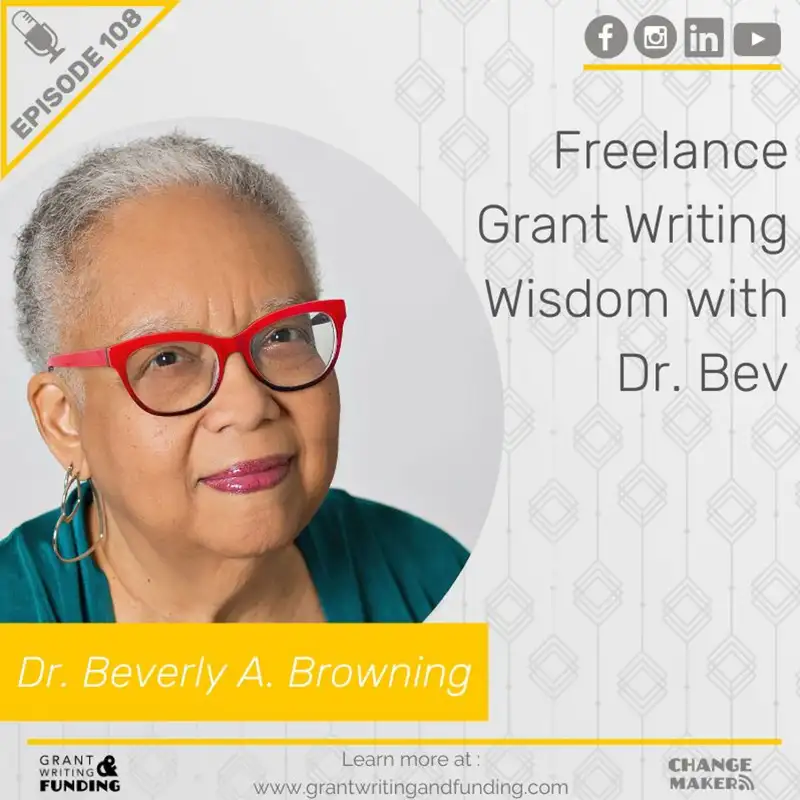
Freelance Grant Writing Wisdom with Dr. Bev
Download MP3Welcome to the grant writing and funding podcast where it's all about, you guessed it, grant writing and funding made easy so you can increase capacity, grow funding, and advance your nonprofit or freelance mission. Now let's hand it over to your host, grants expert and Holly Rustic, so you can increase your funding and drive impact.
Speaker 2:Hi, changemaker. Welcome to the grant writing and funding podcast. I'm your host, Holly Rustic, and I'm here to help you grow capacity, increase funding, and to advance mission. Okay, so before we get into today's episode, we are going to take a little time walk. So in 2007 I took an online advanced grant writing course, and this is back in the day, you know, I had been writing grants for several years, but I really wanted to get more information, I wanted to be better at what I was doing.
Speaker 2:And I loved that course, and I applied all my training and started winning more grants. Little did I know that twelve years later I would get a LinkedIn request from the designer of that course. Okay. I wasn't even on LinkedIn back then, but the point is the Internet was big, disconnected, and clunky back in the day. But more than a decade later, to get a request from author of the grant writing for Dummies books is pretty cool.
Speaker 2:So right away I responded and sent Doctor. Bev Browning a message letting her know of the serendipity and asked her to be on the podcast. She was the cutest, replying that it was her birthday that day and that being featured on the podcast was a great birthday present. So cute. I'm so honored that we connected over LinkedIn and that we got to meet up via a video and have an amazing chat, and you're gonna hear that chat today.
Speaker 2:Doctor. Bev Browning is the person everyone knows in the grant writing world. You have probably heard of her, you've probably heard of grant writing for dummies, you've probably seen her around, and if you haven't you need to check out her LinkedIn, It's amazing. But she shares with me that she first started writing grants back in the 1970s. She's been doing this for half a century and tells all on how grant writing has changed and how you as a freelance consultant can keep up with all the trends.
Speaker 2:She even tears up a little bit in the podcast talking about all of her experiences. And if you want to check out the full experience you can go to our YouTube channel Grant Writing and Funding to watch the video. She's amazing! You don't want to miss on this one guys! So Doctor.
Speaker 2:Beverly A. Browning has been consulting in the areas of grant writing, RFP responses, technical writing, and organizational development for over four decades She has assisted clients and workshop participants throughout The United States and receiving awards of more than $500,000,000 Doctor. Browning is the author of 43 grants related publications, including six editions over 1,000,000 books sold of grant writing for dummies. She is also an international trainer and keynote speaker. In 2015, she was selected by the Centers for Disease Control division to conduct a five day grant writing boot camp in South Africa for ministers of health and other top level health directors from 23 African countries.
Speaker 2:Doctor. Browning holds graduate and postgraduate degrees in organizational development, public administration, and business administration. She has been a grant writing course developer and online facilitator for Cengage Learning, which is www.edtogo.com, for seventeen years and that's where I found her. Her online courses taught to thousands of students annually are Advanced Proposal Writing, Becoming a Grant Writing Consultant, and A to Z Grant Writing Part two: Beyond the Basics. That's the one I took.
Speaker 2:Doctor. Browning is founder and director of the Grant Writing Training Foundation and CEO for Bev Browning LLC. She was a seventeen year member of the Grant Professionals Association and has presented training workshops and keynote presentations for multiple GPA chapters U. S. Wide.
Speaker 2:In 2017, Doctor. Browning joined the Association of Fundraising Professionals and was a workshop presenter at their twenty eighteen International Conference in New Orleans. She is an approved trainer for GPA and CFRE International. Doctor. Browning has been married fifty three years to John and has one daughter, Lara, a licensed therapist and also has a special needs granddaughter.
Speaker 2:To find out more about Doctor. Bev check out www.bevbrowning.com or find her on LinkedIn at BevBrowning. And just a little preview, we will be having our own grant writing course coming out next week. Alright guys, I really hope you enjoy this podcast. Without further ado, here's Doctor.
Speaker 2:Bev. All right. Hello, all you grant writers and grant writing consultants. All right. I'm Holly Rustic, host of Grant Writing and Funding, and I'm here to help you grow capacity, increase funding, to advance mission.
Speaker 2:I'm super excited today. I have a guru on the show today, like for real. So I'm really, really excited to introduce Doctor. Beverly Browning. She is amazing.
Speaker 2:You have probably heard her name before because she has been in the grant writing, a forerunner in the grant writing space for more than four decades. So this lady, like, man, she rocks it out. I see awards and accolades all over that you have been able to get, and just your background is amazing. So thank you so much for being on the show with us today. Doctor.
Speaker 2:Bev.
Speaker 3:You're welcome. I'm honored to be here. Thank you for inviting me, and I'm just excited to connect with your subscribers.
Speaker 2:Yes, yes. And I know a lot of them know you, so I had mentioned, Hey, you guys have any questions? Like, Doctor. B's gonna be on the show. They're like, Oh my gosh, I know her.
Speaker 2:So yeah, they're really excited That's about great. Yeah. And just personally, on a personal level, I took your course, Advanced Grant Writing on Ed2Go back in 2007. So, yeah, so it's really fun just to be like, and that was like back in the day, for all you people who remember that, those days, right, where there wasn't a lot of online courses, like this was a little newer, right? Yeah, so it was really cool.
Speaker 2:I was like, this is great because I was working as a consultant for a grant writing company, had, so I had just moved to Kuwait, so I was in The Middle East, and I was like, you know what, I want to be able to build my grant writing skills a little bit more. I've been doing work for you guys, but I really want to up the level and I want to do more. So I was looking, and of course, online, I had to do something online because it wasn't like I could just access a college in Kuwait, right, where I was working to get grant writing skills. So that's how I found you.
Speaker 3:So glad you found me.
Speaker 2:Yeah, so I mean, just to see like the progression of your work. And of course, I'm just going to quickly read your bio here because I want everyone to know how awesome you are. Okay, so but as far as, like I said, you've been doing the work for over four decades. Your clients, of course, include nonprofit organizations, small businesses too, which is great to know, career volunteer and combination fire departments, chamber of commerce's, faith based organizations, and units of government, which is so important. Of course, school districts, colleges, etcetera.
Speaker 2:Like you help people get money and how much money you've been able to get your clients is over $500,000,000 Like that is really impressive that you've been able to bring in that amount of money to help all of the different projects that those types of organizations do. So something we call, what we like to call each other on our showers, changemakers, and you really are a changemaker, Doctor. B.
Speaker 3:Thank you. Thank you so much. It's rewarding when I travel and go across the country and go to places that have contracted with me for grant writing because you'll have to remember all of my work has been virtual or remote. I have not met, I would say 97% of my clients I've never saw face to face. Was just all done through email communications or Skype And so when I go places to do workshops or to travel and I'll say, oh I remember I helped build the expansion on that library or I helped that hospital revamp its senior citizens area that they had for a community meeting room.
Speaker 3:And just to think that those things are still there and they're still standing after so many years, that's when I get teary eyed. Yeah, oh my gosh, what are you
Speaker 2:making me teary eyed? I'm just talking about it because it is it really is it's something and you're you know you are a change agent as far as like you really are out there doing things that impact communities and like you said can keep going. And that's part of, you know, what we try to do as grant writers is keep those projects sustainable so they don't just end after the money ends, but there's other kinds of commitments and relationships that, yeah, that keep it going. That's really fun, yeah, like going to different places and being like, Hey, I built that in a way, right? Like I helped do that.
Speaker 2:And just connecting, do you ever like connect with the people too?
Speaker 3:No, because it's been so long ago for a lot of the capital infrastructure projects.
Speaker 2:Yeah.
Speaker 3:The people are either retired or, you know, they're no longer living. Especially with school districts and all the money that I helped them with I started out in Michigan so I started writing for the intermediate school districts in Michigan and there's so many things but those people have retired, long retired and all the new people probably have no clue how they got a building or how they got bleachers or how they got a theater area for their performing arts class. They would just probably look at me and not even understand that the school district started out with nothing or without an item, and now it's there and they're using it and it's been so many years.
Speaker 2:So interesting, I love that, and I love that you do a lot of your work online because it's really important, you know, as we grow our businesses, and that's why, you know, a lot of people come to me because they're like, you know, my spouse is in the military and I, know, every time we move, like I have to find a new job, and I don't want to do that anymore. I want to, you know, be able to work from home in this virtual kind of space. Or, you know, people that have kids that are really young, and they want to stay home and homeschool their kids, that sort of thing, but they want to do some side hustle, you know, to be able to get some income and to help their community. So, think I definitely see freelancing as a growing space, or at least telework, right, where you're working in different locations. So that's really interesting.
Speaker 2:So you've been doing that pretty much throughout your whole kind of career or after you left Michigan?
Speaker 3:I started this business in Michigan and I started out as a volunteer and I volunteered for three years just helping organizations in the community and then after three years we were really poor and I remember that our stove broke and we couldn't afford to get it fixed it was like $216 so it's way back in the day. And my husband said why don't you start charging people for all that free work you've been doing? Do you think I can really charge anybody for this? Do you think they'll pay? You're getting money for all these agencies in the community the next time your phone rings and they want to know if you can help them with a grant project, give them a price.
Speaker 3:So sure enough, I got a phone call and I didn't even have a computer. I was doing everything by hand and taking it to a lady in the neighborhood to type for a dollar a day. And so the next time the phone rang, because they called my house phone and I was home and I was working full time and I went to college at night, so it was a handful to do all this payback for the community. I said, well you know will you help us with this grant application? And I said sure and I said but I'm so sorry I'm going to have to start charging a fee.
Speaker 3:And they said oh okay and they were kind of you know hesitant and they said well what is your fee? I was really a newbie I said $216 That's how much you need for the stove! I told I said not really that's how much it's going to take to repair my stove. They felt sorry for me because the executive director said you can come down today and pick up the check.
Speaker 2:Was that your first experience of, oh, undercharging? It was
Speaker 3:the week before Thanksgiving. I think they felt really sorry. Aw.
Speaker 2:Yeah. She used to cook a turkey.
Speaker 3:Oh my goodness, wow. That's how it all started. Yeah, that's how the pay part started. The volunteer part started long before that. I was vice president of the United Way agency in Flint, Michigan and it was called the Volunteer Center and we lost our suicide hotline and I went to a board meeting and I got there early, no one was there but me from the board, and the executive director walked in and she looked exasperated, defeated, and I said, What's wrong, Sybil?
Speaker 3:And she said, We are losing our suicide hotline because we don't have any more money to operate in the partnership with community mental health. And I said, So what can I do to help? And she said, Get us a grant. And remember I was really, really young, probably late 20s, and I said, Okay, what's that other than the grant you get if you go to school and get a Pell grant, what is a grant? She lost her temper with me and she kind of threw the papers she had in her hand down on the board table and she said what are you doing on my board if you don't know how to bring money into this organization and you don't know how And bring I felt humiliated, I felt stupid.
Speaker 3:So when the rest of the board came in I asked every board member on there and these were people who were pillars in the community who were on other boards as well, well known, and I said you know we lost the suicide hotline before Civil comes in I want to ask any of you do you know about how to get a grant, how to write a grant request, and where to take it? No one on that 12 member board knew. No one. And these were people in their 40s, 50s, 60s, maybe even 70s. And they said on all these other boards in the community that's what was so shocking to me.
Speaker 3:So I called in sick the next day and I went to the public library and when it opened I went straight to the reference department and I said I need to get books on grants and grant writing. Here was the response: we don't have any books on grant writing or grants but I keep a tattered notebook with information on a couple of the foundations that are here in the City Of Flint. That seed stayed with me no books, no resources, nothing for anybody else to come in there and pick up and learn how to do it and that planted the authorship in me, but first I had to figure out how to write a grant. She wrote it typed well wrote it out by hand had it typed again by somebody in the neighborhood and called the Charles Stewart Mott Foundation and asked to see at that time the executive director Bill White. It was like magic.
Speaker 3:I got in right away. I went in, I told him that I was on the board, that I just wanted to volunteer and help them out and I wanted to write a grant. They gave me a pamphlet that had the directions in it because nothing was online. He said just follow these directions and bring it back and bring it back to me. Don't just leave it at the desk ask to see me.
Speaker 3:So I followed the directions and I wrote everything. I took it to the executive committee and they authorized that I could submit it. We drafted a cover letter and put our names on it and it was all typed out with had the attachments that were required and everything and I took it back and we were able to get $300,000 a year.
Speaker 2:Holy smokes!
Speaker 3:Several years for the suicide hotline. That's Here's the surprise. I had only submitted a budget for a 100,000 and Bill White said why didn't you ask for more? And I said well this is our first time I didn't know that you know I could give this much the first time. So it was him that increased the budget and it was him that initialed it and authorized it without it going through a long drawn out process.
Speaker 3:So it was both a blessing, it was luck, it was being in the right place at the right time, and it made me want to find out more about grants or grant writing. Again, no resources. So I just started getting calls from people in the community who heard that I got this money for the volunteer center and they wanted me to write for them and so that's how I ended up volunteering for three years just writing for any agency that would call me.
Speaker 2:That's amazing that's such a cool story like wow. Like, I usually tell that doesn't usually happen. Like you said, was being in the right place, right time, having that right connection, like, and for you to have initiative. I think that's the part that is the disconnect too, is a lot of people don't have initiative to start that personal relationship like, Hey, I just need to talk to you to find
Speaker 3:out if I'm, you know,
Speaker 2:submitting everything right or can I have the proper thing, right? So it's really important to have that kind of relationship. And yeah, to just be out there, but do you find too, like, you said this was back in the 90s?
Speaker 3:No, this was probably back in the 70s.
Speaker 2:Oh, wow. Okay. Oh my god. So do you find that this was a lot different as far as the grant I mean, definitely there wasn't as many resources. Did you find that the competition wasn't as fierce back then, or do you feel like it's kind of been about the same in different levels since then?
Speaker 3:I feel that there was no competition that could write, and I'm not saying this to pat my back or anything, but I think you have to have the emotion for what you're writing in order to write it well. It can't be like a term paper or a dissertation or some cut and dried boring type of application. And even though there was no way to instill graphics then like we do now, it was the words that were compelling and talking about the calls that came into the center and while they were anonymous, how many lives were saved because that suicide hotline was available and stories from people who came back and talked to the volunteers that answered that hotline and said, if you hadn't have picked up that night, I wouldn't be alive today or I wouldn't be married or I wouldn't have a family. Those are the kind of things that we heard about as board members when we got the report on that partnership. So I was able to incorporate that into the application statement of need and to talk about the people in the community.
Speaker 3:And, you know, we kind of had a one income, one industry community because General Motors was our main event back in the day and people who didn't work there worked at very low paying service type jobs and had a very hard time having basics, taking care of a family, and those were the people that were making the calls.
Speaker 2:Wow, Yeah, so you just had this very compelling story to put behind it as well. That's really nice. And especially to think about that, and I like that you said, I'm using these testimonials basically from the people we serve, and that's a part that I think grant writers tend to forget, or people who are new to grants don't really know what to do. They just want to look at straight statistics or those sort of things, but it's like those really tell the story, right? Getting testimonials.
Speaker 2:Even you can keep it anonymous, like you did, as well. You don't have to have the names and all of that, you know what I mean? But you can really share that story with their own testimonials in such a unique way.
Speaker 3:Every request needs a story, especially if it's foundation or corporate. Not so much in federal where it's still cut and dry, but graphics do the entertaining for us. But in foundation and corporate it's still about a story and some grant writers call that a case study. Well a case study is pretty straightforward. There's no drama in it.
Speaker 3:There's no emotion. There's no empathy. I think it's very different than a case study. I think it is sharing these are the types of people that we would be able to serve and help even more if your funding supported us. It comes down to not your funding will support, you know, one paid volunteer supervisor and part of the partnership costs for establishing or reconnecting the phone line and creating a confidential case management system, that's all great.
Speaker 3:That's a part of an activity. But where's the story that draws the reader that's going to make the decision to fund this organization? Where's the story that weaves them in? They want to know more than just when was it organized? Who founded it?
Speaker 3:What are your programs? And what have you done? That's also great, but it's not anything compelling. If it were a TV show, we'd turn away.
Speaker 2:Right, that's so good. And that's good to also point out the difference between federal and foundation and corporate Yeah, because it is a lot different when you're looking at federal, like sometimes they're like, don't get too flowery, you know, if you will, but that foundation, the corporate, you do have to touch some heartstrings, right? Of course, you need data as well, but it's like to touch and to create the story because people want to be a part of change, right? They want to be a part of impact.
Speaker 3:They want to see their money invested. Want to make a difference with the people that are in the community, that they're there to serve in a philanthropic way. It's just, it was so much easier to get funding then than it is now. That's, I think, things have really changed.
Speaker 2:Yeah, how is the difference? Why do you think there's been such a change? I mean, you know, are some reasons, I know there's probably many factors, and it really is more competitive nowadays, you would say?
Speaker 3:I would say back in the 70s, if a foundation received 10 requests for funding a month, that was considered a high volume review to pass on to vote on by the trustees. I think today hundreds of applications are submitted for every potential grant that's available, and in the case of federal, thousands for a handful of grant awards and you really have to be on queue all the time with the way you're writing checking what is the question they ask and did I answer it. So I use a content editor because I can't edit but because I don't believe we can find our own mistakes because our brain tricks us. My content editor gets a copy of the guidelines as well as what I've written and then can come back and say this you missed the point on this particular response. This is what they were asking for and you didn't address this part of it.
Speaker 3:So it gives me a 100% compliance before anything is given back to the client for submission. And I feel insured or assured as well that the content editor is going to be there to catch anything and to keep me alert on what should be in that application if it's missing.
Speaker 2:That's great. That's like your own internal grant review process or like quality control, right? Because that's what they do.
Speaker 3:And I use a contractor to do this. And she's based in Oakland, you know, I'm in Phoenix, Arizona. So everything's done by email or by moving it into Dropbox or One Hub or one of those vehicles, but it makes me feel assured that I don't have to read it 20 times when I get it back because it's marked up so clearly as to what's weak, what's not weak, where do you need to make some changes, all of that, or you went over by two characters. Those things are important to catch because those are eliminators if you submit it as is without making those changes.
Speaker 2:Right. Yeah, no, that's amazing. And yeah, I mean, even a lot of people, listeners out there, I always encourage all of you guys to become a grant reviewer as well. So to become a peer grant reviewer, to, you know, get on some federal panels if that's your industry, you know, whatever your background is, to learn that process because there is a huge process that goes into awarding grants. And like you said, the more competitive they are, the more that they have to really, you know, attune this kind of process to that, you know, to make sure that they're getting the best grants.
Speaker 2:Yeah. So, just finding the projects that are, you know the highest level and it's really competitive there was one federal grant I just wrote a little while ago and they had some bonus points on it so they said in order to even be at the high level where they would consider you you'd have to have 103 points It was like, Ah, like that's crazy competitive. It's not just, you know, usually it's like 97, 96, like and above, right? And they're like, 103. Okay.
Speaker 2:I have
Speaker 3:to share with you when I wrote my first federal grant application, I think it was, probably the late 70s, definitely late, so like '79, 1979. And it was to the United States Department of Veteran Affairs employment and training division for a veterans program. And I had never written one before, I just got the guidelines and by now we have computers and all of that bulky, but we had them. And I wrote the application and I followed the guidelines exactly and it was funded. It was funded and so that drove my curiosity to see how are funding decisions made.
Speaker 3:So I became a peer reviewer for Department of Justice, Department of Transportation, Department of Education, Health and Human Services, maybe a couple more to see what happens on the other side. And here's what I really noticed early on, it's like a jury and we're deciding if it's a no go or a go as far as funding. And three of us are assigned in a team to application and we review independently and isolated from one another and then we come together and compare our scores and then we negotiate with each other on points that we want to add or take away so that we come within a certain point range and there's no red flag for something that's not funded and then they get for instance, if you were a nonprofit and your federal grant application wasn't funded and you asked for a copy of the peer review points, and one peer reviewer gave you 100, the second gave you 75, and the third gave you 35, you would be angry. You would say, oh, two of those were biased. They must know about our agency or something happened.
Speaker 3:They had a bad relationship. They don't understand. So that never happens. By the time the organization gets our peer review scores, they are all within a 10 range of each other and it looks cohesive because we agreed on making those changes. Something I wanted to fund, I may not have been able to fund because the other two peer reviewers convinced me that there were too many holes in the implementation plan so it shouldn't be funded.
Speaker 3:So I learned to be a better grant writer because of being a peer reviewer.
Speaker 2:Absolutely, yeah it's helped me tremendously too. I mean it's just been, I love doing it, I love being able to see all the new projects coming out and to see what people are developing, but also just it's always good to have that hat on when you're writing a grant. What are they looking for? You know, what exactly, how would they be reviewing this? Would I be getting a strength on this?
Speaker 2:Would they be shooting any holes in what I'm saying? So it really and plus you get a little stipend, so it's not bad, you know, you get a little stipend for your time, which is quite nice. So it's always a win win. So yeah, it's definitely amazing to help people become better grant writers.
Speaker 3:It is, and it helps us become better teachers of grant writing in any venue, whether it's a workshop or an online class or just helping another colleague who's starting out in the industry because we know what will work and what won't work so we can prevent them from having the kind of rejections that we may have had before we knew what they really wanted.
Speaker 2:Right, exactly. And it really is. It's, and it's subjective, you know, that's what it really taught me too, is the review process is very subjective, even though we're trying to make it as objective as possible, right? You have the three people, you have your chair person, you have, you know, you have to come and debate, but, you know, I even I remember this one guy, one of my, review panels, and he was like, I'm just I'm just old and tired, so that's why I'm giving him a thirty year or whatever. Like, you know, it was funny.
Speaker 2:It was like, okay, but we gotta come back to reality, and you have to give your reasons why, but, you know, sometimes it is. You get exhausted because it's a very intense period of time, and, you know, you gotta realize that people aren't necessarily, like, fresh and clear reading your grant. You know what I mean? So you gotta yeah, so it is even more important to stick to the rubric that they have so you can make sure that you stick to all the criteria and the points. Yes.
Speaker 3:So now we do it online at the background. But before that, we were flown into Washington, put up in a hotel. They would usually book the whole hotel. They would fly in anywhere from 200 to 400 peer reviewers, and we'd all be sequestered in our rooms and there would actually be hall monitors so we couldn't get out and talk to anybody else who was reviewing the same stack of grant applications that we were.
Speaker 2:Holy smokes, wow! That's serious! Get a hall monitor?
Speaker 3:Yeah and we flew in on Sunday and we wrapped up on Friday evening and then we would fly back home on Saturday.
Speaker 2:Wow that's really intense. It's nice doing it out of our homes now, right? Like, that's why I've always been able to do it online. So, and even now, which is interesting, and I'm not sure how much I like this. I mean, it's convenient for the reviewer, but a lot of them that I'm doing in the beginning, we'd always do calls, Right?
Speaker 2:And now, like so after you independently review, you submit your scores, you submit everything, then you come together for a call so you can have that interpersonal kind of negotiations and kind of talk it out. But now a lot of the ones that I'm doing, you just submit everything online, and only if there's a big disparity of scoring will they actually pull you together. I thought
Speaker 3:And when they do that, you have to go back into the online system and make modifications to your review.
Speaker 2:Yeah, it's weird though, right? Without that conversation, like they don't even have conversations.
Speaker 3:Very much so.
Speaker 2:Yeah. So it's almost gone completely opposite, which I understand they save tons of money, you know, it's more convenient for everyone. But yeah, the calls were quite nice. And it really depends too on the different agency, right? So even if they're all federal agencies, like SAMHSA is going to do it their own way.
Speaker 2:Administration for children families are going to do it their own way. So, you know, like they all have their own process kind of, but it's similar. But yeah, interesting.
Speaker 3:And many are contracting it out to a third party because I'm always contacted by an aerospace contractor, which is unusual. And they take care of all the pre screening applications, payment information, and then you work through the system once they give you the login everything to the background for those grant applications. So it is very different now.
Speaker 2:Yeah, totally. So just kind of going back, I know we kind of went off on that, everyone do become a peer reviewer. I love this. But going back to the competition, like and how it's increased, do you find that there is more nonprofits out there, or maybe there's more resources for people to apply for grants, or it's, you know, like, why do you think there's so much more competition than there was, you know, like a few decades ago? Like, because is it the internet, you know?
Speaker 3:Because we have a lot of nonprofit organizations that are newly formed that depend 100% on grants. So they're writing, writing, writing, writing, writing. And then we have the nonprofits who know better because they've been formed for quite a while. But instead of having the right percentage of divisions of revenue, instead of having like 20% for grants, 40% for individual contributions, 20% for endowment development, maybe special events are going to bring in money, that's another piece of the pie. They don't do that.
Speaker 3:They rely too much on grants and kind of slack off on all the other areas of revenues. And what's amazed me is that nonprofits that have been out there fifteen, twenty years don't have an endowment that was set up by their board and their initial donors that could have done that back on day one when they started the organization. Instead they were concerned about operating expenses and now that it's more difficult to get those in the form of a grant because now you need to expand a program, research something, start something from new, not just keep doing the same thing over and over, they're hurting because they didn't follow the steps for solid nonprofit development early on. I just shake my head when they tell me they've been out there twenty some years and they've never had an endowment or they don't have a development department.
Speaker 2:Right, right and how would they go about then developing an endowment or, you know, this whole other kind
Speaker 3:of First, they need to meet with their board and talk about the possibility after doing their due diligence on what an endowment is and then they need to meet with the nearest community foundation because typically it's a community foundation that manages the endowment so that the funds are earning interest with a large depository that's been invested versus a small amount like $50,000 that's not going to earn a whole lot of interest in the first year. And they need to understand that the endowment principle is never touched, only the interest comes out to the agency and they can designate how they want that interest used toward expenses, towards restricted, towards special programs, towards capital improvement. It's at their discretion. But the beginning is to do your homework, meet with your board, share what you've learned, ask someone from the community foundation, invite them to come into a board meeting and just spend that entire hour or two hour timeframe with them explaining what an endowment fund is, how to get it started, and how they can help launch that endowment fund. It is to me the biggest deal possible that every nonprofit should be involved in.
Speaker 3:We can't just keep putting out fires and worrying about making payroll this week or this month. We have to think that if this was our vision, this was in our heart and this was something that we really felt was worthwhile when we created this nonprofit, Don't we want it to be around long after we're gone?
Speaker 2:Yeah, I love that. Yeah, and that is a great step to beginning. Do you see like, is there a certain amount that people should start with? Like, you know what I mean? Like that they can get investment from that they should be asking for just to be able to initiate that process?
Speaker 3:When they talk to the Community Foundation, there will usually be a base deposit that has to be made in order to start it. Now, I can't tell you what it is today, but when I used to advise nonprofits on this they needed a minimum of 10,000 to get it started. Today obviously with time and money it could be 50,000, but this can come from many different sources. They can do a campaign and there are foundations out there that will fund money towards an endowment fund help get But it the board has to step up first, The board needs to make a pledge first and commit to that pledge so that they have some matching funds to go out there and say, hey, our board raised 25,000 over the last eighteen months. We would like to request 25,000 to match this so we can have an endowment fund created at the ABC Community Foundation, which sounds a lot better than saying, because we're going to manage our own endowment.
Speaker 3:That is not the plan. It should never be the plan.
Speaker 2:No, that's great. I mean, that's fantastic, and I see that that's what a lot of nonprofits don't look at. They just look at those operation funds like you're talking about and how do I make payroll? How do I do this? And it is chasing the money, right?
Speaker 2:So chasing the grants. And a lot of those grants, like you said, and I've even seen it, you know throughout my years of grant writing too it's beginning progressively getting harder and harder to get grants you know and the more applications there's more competitors out there there's so many non profits popping up So it really is, you know, and even as a grant writer, I'm like, you should look at other ways of getting money. You know, for a fiscally healthy nonprofit, it's not just grants. Really is doing a series of different streams of revenue so you make sure that you have a healthier nonprofit but there is that disbelief. Sorry, go ahead.
Speaker 3:I agree. Yeah. So right. And the other thing I always ask them is, has your board been trained? Because their job is to connect you with money and the community.
Speaker 3:They're the bridge and if the board hasn't been trained and all they're doing is coming to a board meeting and sitting down and going over the agenda and then leaving and you don't see them again until next month, those are huge red flags. So I think it's frowned upon in some areas of consulting for board members to have a give or get policy. It's considered old school, but I still believe they need a give or get policy. They need to commit. They're not just there to sit in the chair.
Speaker 3:They need to commit financially, and they can vote on the amount that they're going to commit to annually, which means if you have someone on your board who represents your constituents, I'll say homelessness, you know pretty well they're not going to be able to make a give or get commitment at the same level as somebody who is a working executive, a manager, or a CEO. But that give or get level can be set individually for each person's ability and even if you tell your homeless person who now has temporary shelter, take a year, here's an empty mayonnaise jar with a top on it, Just put a few pennies or nickels in each month and whatever you bring back to our annual meeting in December, that will be your contribution. We're not going to put an amount on you. It's just what ever you can without going hungry, without going without a shelter tonight or a coat in the cold. I think it's important to give everybody the ability to be a participant in the give or get without feeling shut out or they have to quit the board because the board set it at $2,500 a year and for them that means they would miss making a payment on something dire.
Speaker 2:I love that. I'm totally agree with you on that because there's so many people too that just want to jump on a board because they want to stay on their resume or increase their whatever positioning in the community that are just showing up to the meetings and aren't really driving it forward. And once you have those kind of commitments, which like you said oftentimes aren't sexy or attractive, but it works, right? It's like it's really saying I'm here to serve, you know, I'm not just here for my ego to be served, but I'm actually here to serve my community, and I commit to this. And I think that's fantastic.
Speaker 2:I'm actually all for that. But you don't see it being passed, you know, with a lot of boards, but I think it is, it's coming back. I feel like that trend, I'm hearing it more and more.
Speaker 3:It is coming back. Absolutely. And also what's coming back is more structure. A structured board meeting that doesn't go amok and run for three hours when it was supposed to be an hour. Also meeting virtually like this instead of requiring people to leave work and drive across town and sit there for two hours and, you know, fall asleep during the board meeting, making it convenient.
Speaker 3:But a board member needs to have a job description because otherwise they don't know. Have no idea what their role is. It's not just the executive officer. And they won't know if you don't give them that. A good board member puts in twenty hours a month for the organization that they volunteer for.
Speaker 2:Oh yeah, yeah, that's great. Man, I'm taking notes.
Speaker 3:Some funders actually ask that question in their grant applications. What percent of your board donates annually to your organization? And if you put anything less than 100%, you're not getting a grant award.
Speaker 2:Yeah, that's so interesting. I haven't seen that one so much. So that's a good thing that's coming out. And maybe it's because all the proliferation of all these startup nonprofits, it just seemed like, oh, I was kind of a mess. And maybe now that's why you're saying there's more structure coming back.
Speaker 2:There's more, you know, commitment with board directors. So they're really seeing there's a need for that to really, you know, because otherwise, it's just they start up nonprofits, and then they dissolve like that because they don't have you know, they're like, oh, I thought I could make a million dollars in the first three months, and that didn't happen. So peace out.
Speaker 3:As grant writing consultants, we can't help these organizations until the board has their act together because if you're writing an application and the board hasn't been doing their due diligence, they don't know their role and they haven't reached out to anybody in the community to help establish that bridge of communication, our efforts are really going to just be wasted because when the application is rejected, you know, we get the blame getting paid but not getting the money, but there's so many other factors so now I really pre screened. Was like who's on your board? What are they affiliated with? Do they have the ability to give? In your bylaws how long is the board term?
Speaker 3:If it's until death then your bylaws need to be revised, rotate out and get fresh blood quite often. If you don't have a strategic plan I'm worried because it means you have no clue you just want this money to run here, run there, go in every which direction. I want them to be accountable because then I can be successful.
Speaker 2:Right, I love that. Yeah, that's so important all of those items. Yay this is a great checklist for those of you listening or watching this is a great checklist for you to have when you're getting set up or when you're helping work with other nonprofits, right, to even have in your arsenal. So going on to that, so we looked at some of the trends, you know, over the years as far as grant writing with nonprofits, and as far as you work with people, of course, to help nonprofits, like you write grants, you also do coaching, you have online courses, you also, and you are in the franchise of the grant writing for Dummies, so the For Dummies books, you definitely have your signature on that, and I believe you've had at least, is it six different versions of that?
Speaker 3:Yes, the sixth edition came out in 2016.
Speaker 2:Oh, congratulations. That's amazing. And you have an arsenal of books now. So I love that, you know, back in your twenties, you walked into a library, you found no books to help you with grant writing, and that kind of nugget grew. And now you have many different books on how to write grants and on nonprofit structure as well.
Speaker 2:Is that correct?
Speaker 3:Yes. In fact I feel kind of lost because I'm used to writing something every year, either updating dummies or coming out with a new ebook or something. And I have to say that since 2016 I've only written one book and it had nothing
Speaker 2:to do with grants. Oh really? What was it?
Speaker 3:What did
Speaker 2:it have to
Speaker 3:do with? It's a journal and it's called Be the Shining Light and it's to help people that are at a point in their life and in their career when they just need to self assess and figure out how they're going to get to their goal, how they're ever going to reach their goal when it seems like everything else is coming in front of them to keep them from reaching that goal. And they write in it and they can reflect in it and I've done a few keynote speeches on it. It works with any industry not just grant writing. It is be the shining light and whatever kind of work you do you can still be a light in that work but you have to assess what you like about it and what you don't like about it and if there's so many don't likes what's your next step?
Speaker 3:What are you going to do? Are you going to take some classes? Are you going to go back to college and get another degree? Are you going to leap into another career and learn it from scratch? Or are you going to start your own business?
Speaker 3:But what are you going to do so your light shines brightly? So that was kind of a left field book. I never thought I would write that kind of a journal. It came to me dream, the title, and I didn't know what to do with it. So six months, what am I going do with be the shining light?
Speaker 3:Be the shining light as a grant writer? Sometimes! Yeah and then I just kept thinking and I filed a you know trademark on it and everything, copyright, and it's like okay now I have to write it and when I started actually started writing it just flowed it just came through me and my keys on my computer were going so fast it's like where is this coming from? How do I even know what to put here? I'm pleased with the book.
Speaker 3:I'm really pleased with it. It's not anything that's a best seller. It's not like dummies. It is very personal and I don't even sell it anymore. Just give can it to people on the have it.
Speaker 3:Mean, we'd like difference while we're here. Don't we want to do something altruistic? You know, I can't give thousands or millions of dollars to philanthropy. I still, you know, I'm taking care of myself and my husband as a caregiver. So that's something I can do for people is stop asking for a few dollars for that journal and just give it to them.
Speaker 3:And if it makes their life better, then that's great. So anyone can request a book. I'm on LinkedIn. Just look for my name Doctor. Bev Browning or Beverly Browning.
Speaker 3:Connect with me and ask for the book and I can attach it. It's in PDF form so any of the listeners, you know. Oh that's so wonderful!
Speaker 2:Yeah I'll definitely have the link on the website. So, grantwritingfunding.com and I'll have your link for LinkedIn and all your other links, but this is great. So, the shining light is what it's called.
Speaker 3:Be the shining light.
Speaker 2:Be the shining light. I love that it came to you in a dream and then it just like flowed through you like so quickly. Like that's amazing.
Speaker 3:It is. The cover has a butterfly and the butterfly's wings are closed because you're not going to open those wings until you look at who you are and what makes you happy and where you want to go.
Speaker 2:Wow, that's amazing. So to kind of segue into that, I'd love to, yeah, I mean, ask you, what is your biggest passion behind all of the work that you do? I mean, I know you want to serve your community, but like, of all the different things that you do, what is the thing that brings you the most joy?
Speaker 3:Being able to leave a path, footsteps or a legacy for others to learn and to be excited about and to want to be the best that they can be, not just in this industry, but in their lives. I am a big believer in random acts of kindness and doing something for a stranger and not expecting even if they don't thank you it's okay. The fact that you did it so it's about how many things did I do that helped other people and have I done enough and am I worthy of this life if I am holding all these things that we used to call our secrets in in the grant writing industry where you know we didn't want to teach anything, we didn't want to tell anything, we wanted to keep it to ourselves, we didn't want to help other people learn how to enter this industry and how to write and I'm not like that. I want to share with people, I want to give them what I know will work for them so they don't fall off the ladder before they get to the next step. I'm 71 now and you know I don't know what my longevity is but I know if I don't become a conduit for being open and giving that nothing in the universe is going to come back to me to help me advance to my next step.
Speaker 2:Right. Oh, that's so wise. So, and happy birthday! You just had a birthday recently, right?
Speaker 3:Last month! Yay!
Speaker 2:So excited. But I love that. I mean, I love that you just have so much joy to help other people and to have this legacy. So I was like, oh, I'm feeling the passion. But how do you like, okay, how do we get to that?
Speaker 2:Like you said, you still have to provide for your husband and you're his caregiver for yourself, right? And even with me, I'm a single mom, right? Like I have to like, I gotta keep food on my table too. And, you know, people are always like, Oh, Holly, on my board. I don't have enough money to pay you.
Speaker 2:Can you, and I'm loving their project, but I can't, you know, sometimes you have to say no, or you have to set up your boundaries in a very healthy way where you can still give back. Are there ways, because I know a lot of people struggle with this, right? Like, not just how to say no, but how do I provide for my family through grant writing, but also help my community at the same time and feel like I'm really giving?
Speaker 3:You have to one, as a grant writing consultant, diversify your revenue streams. All your money cannot come from writing grants. You have to incorporate training, webinars, training that you actually fly out to or go out to, as well as training locally. Webinars, you have to be authoring books because that helps get your name out there, and you also have to be willing to go through a metamorphic change and that's what I'm going through right now. Whereas the revenue from grant writing isn't what it should be or what it has been over the years.
Speaker 3:It is, I think that many of the nonprofits, mid sized to small, are anticipating a downturn in our economy. And so because of that, consulting is no longer a liberal line item in their general operating budget. They're more concerned about meeting expenses, rising rents if they don't own their facility, all of those things. So consulting is the last thing they want to expense out to. So with that and knowing that, it means we have to do other things.
Speaker 3:So not only do I do the board training but I also do compression planning. It has nothing to do with grant writing. I went to train last year in Texas outside of Dallas and trained with Patrick McNeillis. He is the author. His father actually is the guru and the founder and then Patrick took it over and worked with him and now works after his father's death.
Speaker 3:But being able to stay in a training for that many hours and days to learn how to facilitate a better way to plan. Strategic planning takes a long time, sometimes six months to a year to plot it out in a very grinding, grueling way, whereas compression planning can happen in as little as two and a half to three days. Anybody who's stuck on a rock and can't move forward has an action plan by the end of that third day. And it's expensive, know, the fees that we have to charge, and I haven't done a lot of them, but I've done several, and it has moved organizations along. I've done it with a colleague, Kim Joyce, who went to the training together but that was one way of getting a new skill because I feel like and this is a horrible term but old dogs can learn new tricks.
Speaker 2:Absolutely!
Speaker 3:I'm always taking online courses. I don't have one now. I'm studying the evolution of Christianity just personally, but I see myself working with smaller non profits who have less money, who can barely pay, which is you know difficult for me to plan a budget when somebody is late on their payment and the payment is so low you haven't charged that rate since 1982. That is difficult. I'm just doing whatever business I can while I figure out where am I supposed to be next?
Speaker 3:What's my purpose? What's my role? Is it still in the grants industry? And I love writing. I love the creative part of it and spinning.
Speaker 3:I call it wordsmith or spinning word spinner, I guess. I love that and I'd love to do more, but if the phone's not ringing or I'm not getting emails then what do I need to learn to do next? Make sure that I always have a viable and sustainable income. I'm nowhere near retirement, I'll probably never be able to retire, and I'm excited about the fact that I'm going keep my brain active, I'm going to learn a lot of new things, and I'm going to continue to help people. The fees will be less, but if I have enough of less, I'll have more.
Speaker 2:Oh, I love that. That's so good. Wow, my gosh. Okay, so as far as people getting new into this, okay, so now they're like, okay, so I have to maybe, you know, I'm getting new into being a consultant and I really wanna be able to, you know, be able to get there, but now it sounds like I need to charge less and I need to have more clients. Like, do you you know, and I should be able to just jump into this right away and start charging these high amounts.
Speaker 2:Do you kind of suggest that people may be new to the game, new to grant writing even, that want to become a grant writing freelancer, volunteer like you did in the beginning?
Speaker 3:Volunteer, become a board member of a small nonprofit that's just getting started because that's who's going to need them the most, and volunteer enough so that you're writing at least one application a week. One a month's not going work. You're not going to learn this industry. You can take a lot of classes or you can read a lot of books, but you actually have to do it to feel it, to know what's expected because funders are all different. They have so many different requirements, but basically it's the same information just in different, said in different ways or written in different ways.
Speaker 3:So volunteer, become a board member on a small nonprofit, help guide them, help get them to the place they need to be so they have a board on fire instead of a board that is flat cold and doing nothing but sitting in a chair and listening. And then I would say after a year to eighteen months, let them know that you want to continue to work with them, that you'll resign from the board because you cannot be paid while you're sitting on the board for providing a consulting service. That is totally unethical. Resign from the board and become their contract grant writer or their in house grant writer if you want to go to somebody else's office every week. I don't want to commute.
Speaker 3:I don't want to be in someone else's office. I want to be in my own home office which is fully equipped, I have subscriptions to every kind of grant making database, and I can work more effectively here. I'm not interrupted constantly by other people wanting to chitchat or meet at the water cooler or Hey, come go out to lunch with us. I can eat my lunch and work right here. I am a workaholic and on the days when I don't have any work, I feel like I need a shot of something to bring me alive because writing and consulting and helping others gives me life.
Speaker 3:I love that. I love that.
Speaker 2:And then you also you have do you have an opportunity for people to work underneath you, like to be consultants underneath you as far as grant writing? Do you have that capability?
Speaker 3:I do. Often I will take a grant writer who is new, not brand new, but has been out there maybe six months to a year, so they understand what's expected. And I'll give them a piece of a narrative to work on or to research to see how well they do. And then if they do really well they go into my subcontractors on call file where I have an updated resume, a copy of their W-nine form, and can call on them to help. I also work as a contract manager, whereas if I get a large grant because I don't usually write a lot of federal on my own anymore, and I don't want to work in the grants.gov workspace.
Speaker 3:I think that's the client's role, not my role. I just want to get what the talking points are. So I will contract out other consultants around the country that have already established their business and are doing well and they get their full rate. I don't nickel and dime the people that I work with. I'll always say what's your fee for working on this application?
Speaker 3:Here's a copy of the guidelines, Here's the due date. And then once they give me that fee, I then add a small percentage on that and then give my main client the fee for what it would take to do that application. And then that way I get copied on all emails. I'm not only I'm managing the contract but I'm also providing oversight to the I entire get copies of all draft documents, I'm in all the conference calls or else get a copy of the recording if I can't make it, the dialogue, and I know the activity and the effort that's going in by the sub client and by the grant writing consultant that is my subcontractor. So I've done that this year and I've been able to help a lot of other people over the last few years doing this subcontracting build their businesses substantially and pay out thousands of dollars for them to work on projects.
Speaker 2:I love that it's like you're the QC on the program, you're the quality control.
Speaker 3:I have the connection that they don't. I can bid the price which is higher and then that gives me some dollars for watching over and then that gives them their full fee without any nickel or diming and as soon as I get my first 50% check from my client they get paid the half of their fee upfront at the time they start work and then the other half comes ten days max literally from the time the client pays me as soon as that check comes in automatically through ACH I have paid my subcontractors they never have to wait days and days and days for payment.
Speaker 2:That's beautiful. That's a wonderful program do you have. And do the subcontractors, so that they may not have taken your courses, do you have anything where they have to take your courses to be able to consider it underneath that?
Speaker 3:No, they have to understand what a goal is and how to write a SMART objective. Those are probably the two most difficult things in any application. And next they have to understand how to do good quality internet research to build a statement of need. It's not just we need, I hate that term we need. It's like who's we?
Speaker 3:You're talking to the funder they're not in this yet literally. So I really look at how they write and then say okay these are the things that I don't like. Are the things that you know when you do your logic model this is not a logic model. This is what a logic model should be. Here's some examples.
Speaker 3:Take my course when this is all done so it'd be better prepared next time. I love that. About the writing and the way the writing should read because I want funded. Somebody's paying me and they expect a return on their investment.
Speaker 2:I love that. And I love that you're talking about like you have to diversify, like you've diversified very well in what you do and you're constantly kind saying, well, what else can I do? Right? So you're looking at the need. Every day.
Speaker 2:Yeah. That's amazing. And you spend a lot of time on LinkedIn, which I think is really, really cool. And that's where I want everybody to go who's watching or listening because you have a really big portfolio on LinkedIn, you have a LinkedIn group, so that's really fantastic. So you offer, you know, references and these are things coming up and just having that institutional knowledge of the past forty years or so, right, to know kind of like where these trends are.
Speaker 2:And I think that is so impressive and it's so important because we just come new to the scene and we're like, oh, it's, you know, 2019, almost 2020, or this is gonna be aired, sorry, 2020, we're gonna be saying, okay, what's going on politically, and and that's how it always is, and it's like, well, that's not really how it always is. Right? At the same time, we can't just respond to what's happening maybe politically at the moment because, right, it's a bigger picture.
Speaker 3:Yeah, we have to work around it. We have to look for other funding streams and we have to diligently see what's coming down at the federal level, what amount of money has been allocated, how many grants will be awarded, what the cap is on each grant award and what they're asking to be done. That requires a lot of what I call go no go assessment. And you mentioned my group. Thank you so much for bringing that up.
Speaker 3:Really appreciate it, Holly. In my group I've posted four different postings with information about the coaching mentoring program that I'm starting beginning in January. It will be four months, once a week on Saturdays, a group conference call and then anybody who registers, I'm accepting 10 people for these slots for the first cohort, anyone who registers I'll do a thirty minute one on one with them once a month and in order to help them they're going to start out by filling out a five page application that is really a SWAC assessment with their strengths, weaknesses, opportunities, and challenges. And I'm going to build each week's curriculum for that hour long group call on weaknesses and challenges without calling anybody out. It will be topics that everyone needs to help grow in their job as a grant writer, to come into the industry for the first time as a grant writer, in their business as a grant writing consultant.
Speaker 3:So this is all the pre award side. I'm not going be able to do any grants management because that's not my specialty but it will be everything they need to know to write better, to build their business. You have to really be flexible. You can't go in and say this is all I'm going to do. I'm only going to work from three p.
Speaker 3:M. To six p. M. Daily. Well that's going to go down the tubes pretty quick.
Speaker 2:Yeah absolutely.
Speaker 3:You have to be available when your clients need you and sometimes that call comes in at 08:00 Friday night, and they need something Monday morning at 08:00. And it means if you want to stay in this business as a consultant, everything else that you thought you were going to do for the weekend needs to be canceled.
Speaker 2:It is. Love that you have that and I love that both grant writers, so they're working in a nonprofit or people who are consultants can get into that cohort because they do have a lot of similar challenges, right? So a lot of people who want to become freelancers they still want to keep their grant writing skills they want to you know keep them honed they want to increase them like you can you're always working to become a better and better and better grant writer it's never like said and done you know like I reached it. Like you can become better but it's always a process. They
Speaker 3:don't ever want to say to their client or to their employer, Well, I don't know how to do this. I've never done a logic model. Well, put that down for your weakness because we are gonna go through step by step on how to build a logic model and where the information comes from and how you can use it before you ever write the proposal to plan out the proposal or how you can use it afterwards capture what you have in the proposal and build this one page or two page graphic or table to show the progressive steps within from the problem to the solution and what are the outcomes, what are the outputs. So this is an opportunity for everybody to learn and I just want to say that for the last twenty years my internship program has been tuition based and I've charged $3,500 or $4,500 depending on consulting or writing for one person to be with me for three months. These people are going to get to be with me for four months for $250 a month and I'm going have to pay the dollars upfront.
Speaker 3:You just need to pay their two fifty dollars And they need to know that I'm available all the time, not just for thirty minutes in a one to one call or an hour in our group call, but anytime they want to pick up the phone and say, Bev, what is this? I've never done this before, or email me, I'm going to answer them. I'm not going to say, we'll wait and we'll talk about that in group on Saturday. I want to be their go to and they're getting a lot of value. That's huge.
Speaker 3:Yeah,
Speaker 2:that is amazing. So $250 a month for four months. I mean, it's a grand, but if that is $2,500 like discount, and that's huge. That's such a bonus. And I love it.
Speaker 2:It's like, is that capped at $10 then? You said it's 10 people?
Speaker 3:It's capped at 10 for the first one because I really want to address I want to take the time and address everything that everybody needs and if I've got 50 people on that call it's going to be really hard to do. It's going to be too generalized for anybody to be drawn into wanting to, you know, dial back in on week two or week three. So I really want to make this personal. I want to meet all the needs of those 10 people and everything they need. I want to pour into them so that they come out of it and they're ready to do whatever their goal is in this pre award portion of grant writing.
Speaker 2:I love that, that is so awesome. So please check that out you guys, that is amazing. I'm gonna look into that. I love just having the mentorship like it's amazing that half an hour and then that group call like that's amazing value just that in itself like wow.
Speaker 3:So it's on Saturday so people who are working for an employer they're usually off on the weekend and consultants usually have they can give up an hour on Saturday, whereas during the week the phone's ringing off the hook, family has demands, all of that. So it's like, okay, we're going to move this to Saturday so everybody has a chance to dial in.
Speaker 2:That's amazing. So where can they find out more information about this? I mean, well definitely in your group.
Speaker 3:First, they have to be on LinkedIn if they're not there. And then the name of the group is Doctor. Bev Browning's group. It's pretty clear and they just need to request to join and then I go in pretty much four times a day and check for new requests and approve and people are in right away and then the information is there.
Speaker 2:That's amazing. So definitely check that out. We'll have the link on grantreadingfunding.com as well, but if you're on LinkedIn already, just go find Doctor. Bev Browning and you will get that group. You can go ahead and add yourself and she will be checking there for you.
Speaker 3:They'll have their application back to me by December 30 because we start the first Saturday in January.
Speaker 2:Okay, perfect. That's amazing. So okay, so this has been great. So that's what you have coming up right now. So any other things coming up?
Speaker 2:Do you have another I know you said that you're not working on a book right now, but is there anything in your mind or any other I'm
Speaker 3:not working on a book right now. It's about time for Wiley to come back to me and ask me to update Grant Writing for Dummies. I imagine that that could possibly happen in 2020. That's a whoosh, so we'll throw it out to the universe. It's time for an update.
Speaker 3:And each update the book changes, the chapters change, the contents updated, it's more relevant to what's happening at this moment when it's going to be published. I am planning a workshop in Sacramento in April with a group called Better Decisions Counseling and we'll be putting together the marketing information. I went there I think it was two or three years ago and it was so beneficial to help this non profit counseling organization. They got a part of the registration fee. Whenever I have a sponsored workshop where somebody's doing that, I give back to them.
Speaker 3:You get a check right on the spot when I show up, whatever registration came in, they get back a portion of that toward their organization. So that's one of the things I'll be doing planning for April in Sacramento. I don't have any other things planned right now. I usually just kind of these things come to me in dreams and it's like oh this topic you need to do this again, you need to do this again and then I just find a venue and if I can't find a host I just do it under my foundation and then plan it. I have a non profit foundation, grant writing training foundation, then I have a for profit corporation, Bev Browning LLC.
Speaker 3:So I try to do the things that are not going to be full rate or reduced rate under the foundation so that it fulfills the mission of the foundation.
Speaker 2:Right, yeah, that's wow so wonderful talking with you today. So yeah, once again definitely check Doctor. Bev out on LinkedIn. Do go there, that's a great place. And of course, can go to Bev Browning.
Speaker 2:That's bevbrowning.com as well. So you can definitely check her out there too, but that is her spelling too on LinkedIn. So doctor Bev Browning on LinkedIn, right? It's not your full name Beverly, it's Doctor. Bev Browning.
Speaker 3:I think it's under Doctor. Beverly Browning. Okay. The group is Doctor. Bev Browning's group.
Speaker 2:Okay, perfect.
Speaker 3:Everybody in there is a resource person. So you can post a question and get an answer, you you can post a problem and someone will help you solve it. It's just, I think I have a little over five fifty group members.
Speaker 2:Oh, that's so nice. That's such a good resource because we're always like, you're working on something on a grant or something and you just have this question or your board is like, has a question, like it's great to have that resource. Absolutely Well, I could just talk with you all day, but I know I gotta let you go. It's been so wonderful. Yeah, it's been so wonderful having you on today and just getting to know you better.
Speaker 2:You know, it's funny because pre call, were both like, we're both from Michigan, even though we're totally living in different places right Yeah. And it's just been it's so cool, too, just taking your course so long ago, like I said, in Kuwait, and here we are chatting online, and it's just amazing. So thank you for being such an inspiration to thousands and thousands of people.
Speaker 3:Oh, you're so welcome. You don't have to thank me though, you're an inspiration too. Aw, thanks. You've put on your goals all over the world you made them to fruition and now look at you. You're in the ideal location, ideal place, you're doing what you wanted to do and you're reaching so many people.
Speaker 2:Thank you. Oh, that's so nice. So we'll definitely have to connect again. So I'd love to, yeah, well, I'll have to have you back on the show. And yeah, maybe we could also just collaborate in some other initiatives, because I really feel like you're such just a value.
Speaker 2:So and such a such a wonderful mentor. So
Speaker 3:I feel that way for you too. Thank you for asking me to be on your show. It is Absolutely.
Speaker 2:Absolutely. Alright. So thanks so much. Do you wanna join the Changemaker Tribe and get courses, downloadable checklist, samples of awarded grants, behind the scenes live q and a with myself and the tribe, and discounts on grant services? Be sure to join the change maker membership at www.grantwritingandfunding.com forward /membership.
Speaker 1:Thank you for listening to this grant writing and funding podcast. I hope you've enjoyed your time. For more questions, email Holly@hollyatgrantwritingandfunding.com or visit www.grantwritingandfunding.com.