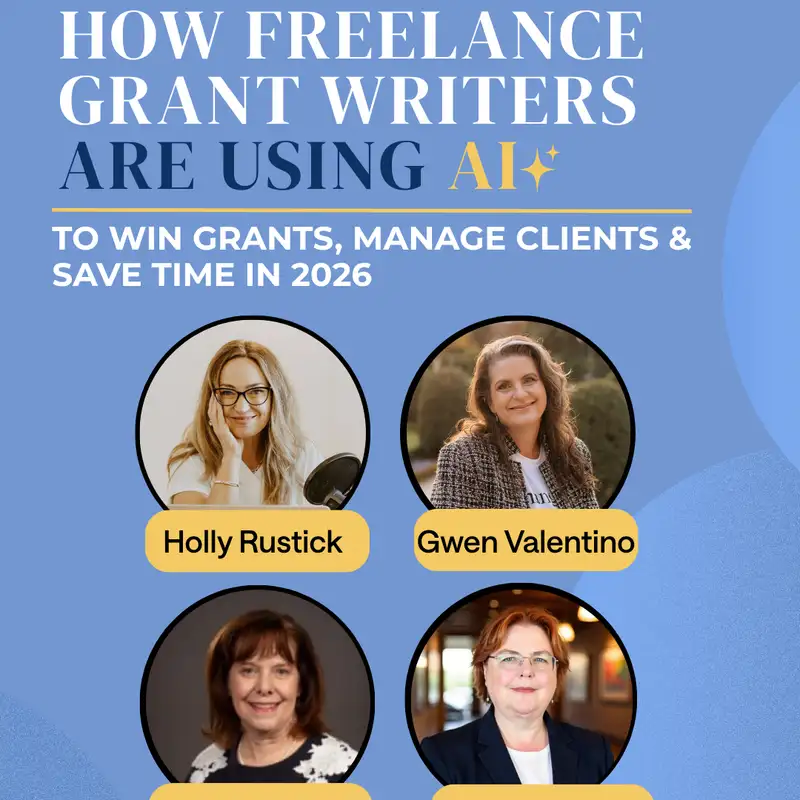
How Freelance Grant Writers Are Using AI to Win Grants, Manage Clients, and Save Time in 2026
Download MP3Hello. Hello. Hello. It's Holly Rustick here with Grant Writing and Funding, and I'm really excited today to have on we have a panel. We have a panel and we're going to be talking all about AI.
Holly Rustick:And what I'm doing is I'm interviewing different people that are actually inside my programs in the mentorship program because they've been using AI now for a while, like some of you for years, maybe all of you. So we're going to be talking about that today and really what you guys are doing behind the scenes in your business, and I'm really excited to hear more because I hear bits and pieces, and I always know there's another thing. Right? So I have three wonderful ladies today on the call with me, and I'm really excited about this. Go ahead.
Holly Rustick:I'm gonna have you each introduce yourself and tell us the name of your company, tell us, what you do, and then we're going to go ahead and open it up to questions. So let's start with Sarah.
Sarah Cohen:Hi, Sarah. Hi. I'm Sarah Cohen. My company is Sarah Cohen Consulting, and I've been a consultant for twelve years, but I've been writing grants for almost twenty seven. I'm very much a generalist, but in my consulting business, I'm leaning more towards K-twelve education and youth development.
Holly Rustick:Nice. Nice. And you're based in Chicago, right? Or you're in Chicago Yes.
Sarah Cohen:The Chicago Amazing.
Holly Rustick:Amazing. Alright. Let's get to Gwen. Hi.
Gwen Valentino:I'm Gwen Valentino. I have New Mexico Grant Writing and my business is also general. I work with a lot of municipalities, and I work with several nonprofits. And, yeah, I've launched a lot of AI apps and processes. AI is my jam.
Holly Rustick:Yes. And you're also a coach in our program, so this is exciting. I'm like, let's get the coach. He's always like, the Holly. I got this thing going on, so I love it.
Holly Rustick:Awesome. Thank you, and welcome. And let's continue traveling west. All right, Nick.
Nic Daniel:Hi. I'm pretty far west. My name is Nic Daniel, and I'm the President of Key Development Group. I've been doing this for probably close to thirty years. I'm Los Angeles based.
Nic Daniel:I've got a team. My team acts as an outsourced grants department, so we take care of the entire thing front to back in terms of grants. We research, and we write, and we do grant reporting and tracking and all of those sorts of things. And while they're doing that, then my specialty within that is that I work in major grants, which is a relatively new category, at least in terms of having a name, which is where, you know, I'm specializing in capital campaigns and capacity enhancement, working with organizations in transition, and doing those sorts of things. So we sort of encompass that whole thing for organizations.
Nic Daniel:That's it for me.
Sarah Cohen:Love it.
Holly Rustick:Love it. Awesome. So you all are just wonderful changemakers. You've been obviously writing Grants for a while, all of you. So this is also like I also want to mention to our audience a more seasoned grant writer approach to AI.
Holly Rustick:And I would love also, like, we may have newer grant writers come on and talk about that as well. But I kind of did this on purpose because we've seen that those who really have more grant writing experience and skills have been able to lean into AI a little bit earlier. And I think there's a few reasons because of that. I think one of the reasons is you already have that skill down. So now learning another one, you have more space to kind of open it up.
Holly Rustick:You have more processes potentially already, too, so then opening it up. But I also just want to call that note, too, if you're listening. It doesn't mean that you cannot use it if you're an earlier grant writer, although I do have some spicy thoughts on that. I still think you need to learn how to write grants first before you use AI. And I'm also seeing that the people who are getting more results right now do have more experience.
Holly Rustick:So I do think this is an interesting panel. When did you all you all have been writing grants now. I think all of you for more than a decade, at least. When did you start using AI? And what can you also tell me, like, there's been a lot of changes just in the last year even.
Holly Rustick:I mean, heck, in the last six months, there's been a lot of changes with AI. Probably in the last day, there's been a lot of changes. But as far as, like, did you start using AI in your business? And then what has kind of changed since you started using it? So maybe you gave up doing something.
Holly Rustick:It just wasn't working, or you've leaned into a new process now that Claude can do more or whatnot. So if you guys could kind of tell me that. So let's go ahead and let's start with Sarah again.
Sarah Cohen:Yeah, I started out, I may be less sophisticated than my other two panel members here in the way I use it. I started out in 2017 when I got Grammarly because I had so much work to do and I did not clients were very bad at editing, so I started using Grammarly for that. And I actually found out that realized that it really did a good job of learning my voice, which I thought was really interesting, much better than I also use Microsoft Office, and the Copilot did not do as nearly as good a job. But then when Claude came out, I jumped on that right away. I still think Grammarly learned my voice better.
Sarah Cohen:Wow. So you weren't
Holly Rustick:using it for edits. You were using it for, like, writing.
Sarah Cohen:No. No. But when I needed there, I don't use it that much for writing. I do not write a whole grant with AI, I'm really reluctant to go that route. I don't like the voice really, especially from class.
Sarah Cohen:Sometimes they go off on a tangent sometimes. If you do enough give and take with them whichever they are then they settle down and they do what you want to do but I kind of enjoy the writing process myself. But I do use it to save me time if I'm like, I don't suffer from writer's block anymore. When I feel that, I use Claude or I'll use Copilot depending on the kind of voice I wanna use. Copilot's very business oriented.
Sarah Cohen:Claude can be a little more has a little more warmth.
Holly Rustick:Yeah.
Sarah Cohen:So it really depends on on what I'm looking for. But one thing that I found out recently, I've got, one kind of challenging client, but it's also my biggest client. And they really don't understand working with even though they're a $10,000,000 organization now, they don't really understand how to work with a grant writer. But I think they'd be insulted if I gave them training. So I discussed it with Claude, my issues, and I'm developing a series of policies for them to also use if I should step down or if they should decide they wanna go another direction.
Sarah Cohen:They'll have a policy handbook for grant writing.
Holly Rustick:Nice. Okay.
Sarah Cohen:And the president, I've only given them three of the policies so far. He was thrilled. Yeah. And Claude is very good at formatting. I'm lousy at that.
Sarah Cohen:Right. Yeah. It was very but it was a lot of give and take and, like, discussion with Claude to get to those, but it was it was fun.
Holly Rustick:Nice. So you're using it more than for the editing process for That's strategy a little bit. Yeah. Strategy. Okay.
Holly Rustick:So, like, okay. How do I kinda create more policies and have these formatted and already ready to go to my clients in that I love that. I love that. And your hesitation still is, like, it's do you feel like is just what I'm hearing? I don't want to put words in your mouth, but, like, from what I'm hearing is it's still not always consistent on the voice, or is it, like, time faster too?
Holly Rustick:Is it does is it taking you more time to write a draft from from AI?
Sarah Cohen:I think it takes more time to write a full draft from AI.
Holly Rustick:Just because you're trying to get the voice right. Exactly. So I can write it fast, but it's like, it good or too
Sarah Cohen:Is it good enough? And then I'll run it by one of them depending on how I want it to sound.
Holly Rustick:Right, right. I love it.
Sarah Cohen:They're all different. Yeah. And also Grammarly, and I don't know how effective it is, has an AI detector. And what's funny though, I don't know how good it is because some of my own personal language has been detected as AI. Interesting, interesting.
Sarah Cohen:Yeah.
Holly Rustick:Okay, so I like this. I like that you're also bringing up, Sarah, like the different types of AI do different things and may assist in different ways. And I mean, every I feel like and let me know, ladies, if I'm right or wrong, but in my opinion too, like, I feel like every software is also trying to be the all in one. Right? Like and is trying to
Nic Daniel:be really, really good at all
Holly Rustick:the things. And I don't know if we'll ever get there. I think, you know, we'll get where more is more functionality for fewer AI tools, but I don't know. It's kind of like it's a weird niche thing right now, and I think people are really leaning into the niches as well of like, this works good for this and seeing the difference. So thank you, Sarah.
Holly Rustick:So let's go ahead and take Gwen. So same question to Gwen. You know, when did you start using AI? How has that changed? What are you really using it for?
Gwen Valentino:Well, as you know from your Academy, I started using it like the day I heard about ChatGBT. I was like, I'm all in. And that has been my focus these last several years is just really learning as much as I can about AI and the way it works. I use multiple different things. I use ChatGPT for some things.
Gwen Valentino:I use Clod for very little because I am not on the Clod bandwagon, but I still I still pay for it because I think maybe I might use it. And then I started developing my own AI because neither one of those platforms were working for me the way I wanted them to. So in the beginning, I would put an RFP into ChatGPT and be like, Help me write this. And of course, I got garbage because I put garbage in. So I have really, really leaned into prompting, and I have made considerable headway with my prompts.
Gwen Valentino:And then I get out really good information. So my prompts absorb the client's information and then sends it through, and then it creates beauty. And I am and I am seeing consistently over the last six no. What are we in? Nine months that it has since I developed all of these, it really has won a lot of grants.
Gwen Valentino:So in the last nine months, I've won about 5,500,000, but that's with municipalities.
Holly Rustick:So
Gwen Valentino:I feel like it's really working. I feel like I got the kinks out, but it took a lot. I would say it's been days and days just figuring out something that I could have just written out, but I wanted to make a long term solution versus giving up because it's really hard for me to give up. So now I can write a grant in just a couple hours,
Nic Daniel:which
Gwen Valentino:translates into savings for my clients.
Holly Rustick:Right. Okay. So are you charging less than for your clients because of that? I am. Really?
Holly Rustick:Okay. Are you targeting a different type of client then or is it the same one?
Gwen Valentino:I am. Actually at GPA, I am targeting that 50 ks and under client is really where
Sarah Cohen:I'm going.
Gwen Valentino:Never known how to serve them the way we're taught, and so I just decided, you know what? This is how I serve them. I serve them by doing fast work, and then they can edit it out on their time.
Holly Rustick:Okay. Okay. And then what about your municipality, like your main bread and butter then? You're using it, but you're not the rates are still the rates. Right?
Holly Rustick:Because, I mean, this is
Gwen Valentino:a real time investment as well for you to look at systems. Municipalities historically give you a grant on Monday that's due on Friday. So this has helped me be able to say yes to them more often than I used to have to say no to them quite a bit, and they just never I've worked for municipalities for years and years, and they never have quite understood how long it takes to write a grant, and this really cuts my time down.
Holly Rustick:I love that. Okay, so your approach is kind of twofold. You're looking at it and saying, Okay, how can I serve smaller nonprofits at a more affordable rate because this is going to reduce my time? But how can I also serve my consistent clients that do pay more, but it's just because they have a faster turnaround? So now I can actually serve them in the right way doing this, but I'm not going to reduce my rate there.
Gwen Valentino:No. Right. I'm not gonna reduce my rate because that takes a lot more back and forth energies. Yeah. Where with the smaller nonprofits, it's more of a quick turnaround.
Gwen Valentino:I have a thing where it's like a forty eight hour turnaround, and that's they just get what they whatever they give me, they get out just as quick.
Holly Rustick:Right. Okay. Yeah. So two different, really two different offers and two different ways they keep utilizing it. Oh, and
Gwen Valentino:I think that's good offers.
Holly Rustick:Yeah. You have a lot. You have lot, but we can focus on those two, Glenn.
Gwen Valentino:I can't. I've tried. Yeah, and then I'm launching the prompt library too as a membership.
Holly Rustick:I love it. I love it. So, so good. Okay. So let's go on and we can maybe talk about that a little more detail, but let's go to Nick then.
Holly Rustick:How are you using it primarily in your business? How has it changed all of the things?
Nic Daniel:So when it first came out, I jumped on board because I was AI curious, and I just thought, you know, it can't possibly write as well as me. I've been doing this for thirty years. And then it produced this thing that I'm like, oh, holy god. I wish I'd written that. Right?
Nic Daniel:And so I was really surprised by the quality that came out of there. And so I wanted to play with that. But what I found in working with the large language models earlier on was that it was I was I was taking so much argument all the time. I'm like, why did you do that? I told you not to do that.
Nic Daniel:Go back and look at the instructions. Start over. Where did you get that number? And I had to prompt and prompt. And if I forgot one of my prompts, it would do the thing I didn't want it to do.
Nic Daniel:And I'd have to redo it with the prompts back in. And and it got exhausting, and I didn't really feel like it was saving me much time. And so I got a little discouraged with it for a while. And then when co work came out, clogged co work, the Agentyx, it was a whole other thing. I was like, this isn't gonna be any better.
Nic Daniel:And once it was able to be connected to all of my files so that it had that whole history, not just the like, with large language models, I would take the last two brands, and I'd attach them. I'd go base it on this, and it would base it on that. But it had this view. You know, with being agentic, it was able to incorporate and sort of get a gestalt, a sort of feel of that client. And my clients are so different each from each other that I know we all want the AIs to write in our voice, but what I need more is for it to write in their voice because my clients are so different.
Nic Daniel:I've got one that really tugs at your heartstrings. And so our what we write is generally a lot of three page letters with pictures in them, and they read a little bit like a end of your appeal letter. Right? And then I have this other organization that is very visionary. The CEO is very visionary.
Nic Daniel:And so everything needs to be innovative and professional and dead on accurate and incorporate a whole lot of updates to a whole lot of projects that interrelate to it in these very complicated ways. And so it has a way of writing like that CEO, and it has a way of writing like the other CEO, and because it can connect with everything. And I really like that. And I've almost been able to stop prompting. Because with the connectivity, I can just be like, Here, we need to talk about this this time, and make sure you do it from that angle.
Nic Daniel:And then it's like, Enough. I don't have to be like, Don't use an em dash. Don't do the It's not X, it's Y. I don't have to do any of that simplistic stuff with it. So, it's really been huge for me there.
Nic Daniel:And one of the biggest things is, you know, when I'm doing my major grants, the capital campaigns and things, there's so little of it that's the grant is at the end. Right? And so up until then, what we're doing is a whole lot of back and forth communication. And so, it needs to be able to integrate materials that go boom, and you get it. Right?
Nic Daniel:Flexibility to present a graphic that's just like, I can feed all of the information into it, and it goes, this is what it's like. And it'll have pictures and graphs and charts and stuff that I used to spend all day on Canva dragging things in and creating. And I wasn't very good at it. I'm not really an artist per se. So this just comes out like, oh my god, professional and polished.
Nic Daniel:And so I use it probably for the materials as much as I use it for for drafting. And even to summarize, just for clients to have internally, like a cheat sheet so they all understand what we're saying and how. And I love what you said, Sarah, about the I already wrote like this. Because one of the things that ticks me off most about this is I used to be a great Em Dash writer. I loved my Em Dashes.
Sarah Cohen:Me too. Me too. No. I was like,
Holly Rustick:I was the Em Dash queen, and now I'm like, I can't
Nic Daniel:use I them can't use it. Have to filter them all out because it just looks like I wrote like a didn't I say X, not X, it's Y all the time, but I didn't do the em dash. So, that's been kind of discouraging because there's some things you just you don't want to sound like that, right? So, then, it just felt like what I can do in terms of grants, if I'm working on on the grant, is that I don't have to draft the language per se. It puts down a base for me.
Nic Daniel:So, it goes and looks up the how much was board giving last year that I used to have to go into my files and be like, when was the last time we talked about board giving, right, and find that number. And this can it just it fills in those boxes. What was the budget last year? You know, two years ago, was $9.90. And so I have it fill in all those and give me the base.
Nic Daniel:And then I start playing with it. Alright. This needs to be more compelling. But it's not the same as the arguing I used to do, like, no, stop it. Right.
Holly Rustick:It was hallucinating a lot then before. You feel are like you completely trusting that it's not hallucinating anymore now that you're using
Sarah Cohen:more No.
Nic Daniel:Okay. Not at all. It's not as people pleasing as the old large language malicious to me. So I don't find that it's like trying to agree with me in some horrible way. I don't always trust it because I have had recent things where it has made up this entire wonderful thing.
Nic Daniel:And I'm like, really? Did they do that? Did I miss that? It turns out like, we don't do that. And so, I've been caught a couple of times where folks are like, it must have found something in the files that said that that's what's happening, and it's not true.
Nic Daniel:And I'm just like, oh, it's an actual hallucination. It happens so infrequently that I find myself, like, having to go now, don't just trust that that's true. You know? Right. Right.
Nic Daniel:So I do have to do some backing up and checking.
Holly Rustick:Okay. Amazing. Amazing. And then, you know, and I think that's so interesting too, to be like, okay, obviously, like, there's things that happen, right? So how do we check?
Holly Rustick:And I think that's also a different part of your brain in a way of, like, processing and looking at it. Like, we've been writing grants, all of us, right, for a long time, and it's using a certain type part of your brain. It's, like, really, like, developing story, like, kind of looking at it and making sure. And then when you're actually reviewing AI, it's a different, like you almost have to like switch. Otherwise, it's like scan, okay, right?
Holly Rustick:Like to me, it's really hard for me to slow down and be like, does that make sense? I'm used to developing it where it would make sense from that part of my brain, so now all of a sudden I have to be like, there's no, I have to, I can't assume here. So I know like what are your processes on that?
Nic Daniel:Fielding, who, you know, is in our cohort, she's I amazing at
Holly Rustick:invited her. Yeah. Oh,
Nic Daniel:man. Was hoping she'd be here. So anyway, so she teaches about this and then does coaching on it. And so she said one of the most valuable things. She's like, when you're done, tell it to criticize itself.
Nic Daniel:And I'm like Yeah. Oh, I can do that. And so, I'll finish a lot of times with that. Tell me what she did wrong. You know, take a look at this, and edit it yourself, and tell and it will come up with this really great that, I really should have done that.
Nic Daniel:You know? Yeah. Really should
Holly Rustick:have done this one. Do that too, and then I'm like, Then why did you just do it?
Nic Daniel:You can't.
Sarah Cohen:Yeah. Gwen, do you want to add in here, too?
Gwen Valentino:Yeah. I developed an app that, like, is a gap report. So my last step is to put it through the gap report, and it'll show me as what a reviewer thinks, what a subject matter expert thinks, all these different places, and it'll actually give it a score on what it's missing. And that way, I can go back and look with human eyes and be like, Oh, yeah, it's totally missing that. Or I could be like, Oh, no, this explained what the client told me, and that's all I have.
Gwen Valentino:So it just gives me a place to go back and look.
Holly Rustick:Right, I love that. Sarah, you wanna add on that too?
Sarah Cohen:Yeah, I like the idea of the gap report. That's cool. But I also I use Cloud Work and sometimes I just use the I go back and just if it's something simple, a large language model, but I give them access to some of my files. And one time, Claude wove together two clients
Holly Rustick:in the And
Sarah Cohen:I was like, no, no, no, no, no, no. You're getting very confused. And that was fairly recent. It was a time when I had a really tough deadline and I was really tired and I almost didn't catch it. You have to be really, really careful because they do mess up.
Holly Rustick:To your point, like, as girls are not gonna get it, they're still gonna
Sarah Cohen:They're still But they're not human. I can't remember that.
Gwen Valentino:That's absolutely always say treat them like your laziest employee. They're gonna get but it are they gonna do it right? You don't know.
Holly Rustick:I love that. I love that. So thinking about that from that lens too, right? If you look at it, and I think what you're all looking at too is you've been writing grants for so long. You you can see those things.
Holly Rustick:And I think that's also kind of what makes me a little nervous with newer grant writers that might just not catch that or have those history. You know, you have this history of clients where you can catch that. Right? Like, you're like, Sarah's like, oh, that's two clients. Where have you didn't really ever you would, like, process through them.
Holly Rustick:So is a way to process through also, like, onboarding? Right? Like, onboarding your your calls with your clients. Can you guys talk about, like, has that changed at all now that you guys are using AI? Or have you been able to, like, think about that in a different way as far as, like and I'm not just talking about using, like, a fathom recorder, but, like but you could definitely share that with me if you want.
Holly Rustick:But as far as, like, is there any other processes? Because you're like, I actually need more information potentially to train my AI. Right? So have you has the questions that you're asking or your conversations or anything like that changed because of AI? Let's start with Nick this time and go this way.
Nic Daniel:Okay. Well, I think the way that I work with my team is different. Because you always want your grant writers to write it exactly the way you would. Right? And everybody's different, and that's not going to be easy.
Nic Daniel:And also, most of my clients have been five to seven years with me. I just know, you know, and it's stuff that I can't convey and pass on. I think that it's worked really well with working with my team so that I ask them to start off the way I do and train them with Scribe to these are the SOP steps that I would do, and you can connect right to my files. And so you connect your cloud with my files. You're gonna basically come up with a lot of what I would have come up with.
Nic Daniel:But then that second pass thing where it gets the basics down, and then I don't have them spending a whole lot of time on just doing the basis of looking up last year's, you know, revenues. And so when it puts the base down for them, then they can look at it with their eye, and that may be a little bit different. But we're starting starting from from the the same same place. Place. And so that's helped a lot, I think, and that's been different.
Holly Rustick:Okay. So as like, you're training your team and how you're applying it has changed.
Nic Daniel:Okay. I work consistently working together, and my assistant is doing the same thing. She's Yeah.
Holly Rustick:What about any interactions with your clients? Has that changed at all?
Nic Daniel:Yes. You know, we've talked about it, and they have varying levels of comfort level with the use of AI. And some of them are very likely they do it themselves. I get my more innovative client will just send me his AI. Here's what here's what the program is looking like, and he'll just dream this program.
Nic Daniel:Right? And then I get it, and then I can write about it because that's the basics. Then with the meeting transcripts, then we incorporate everything together, and we'll talk back and forth with let's say, do you think this is a good funder? I'll send him the AI report back that says, here's why it doesn't work for this organization. And he loves that.
Nic Daniel:With others, I can tend to try to make it more me because I don't know if they're always comfortable with seeing stuff that looks quite stylized. Yeah. So it it's changed the way that I've done it because I could yeah. I wish that there was a greater comfort level out there. You know?
Nic Daniel:Everybody's getting there. But sometimes I have to start with that and then put it in my own words and things just because not everybody's really cool with it. And there was a grant I wrote really recently that I thought came out fantastic. It was all the wording that we haven't used before and describes, I thought, things really well. And the the first reaction was, did AI write this?
Nic Daniel:I'm like, probably just because he didn't sound like me more than anything else. But but also, there was one sentence that she found that didn't make actually make any sense when I thought about it, but it sounded really cool. God. I gotta catch those. You know?
Nic Daniel:Great words. But in the end, it's like, what does that even mean? So, yeah. So there's this thing between us now of everybody's different opinions on how it's used or not used. I always follow the way the client wants it done.
Nic Daniel:They want me to be hands off with AI, I don't have anybody who's completely like, don't like it. You know, I had a client that I was with for twenty years that I think was not going to be comfortable making that transition. And we decided to part ways for other reasons that were, you know, amicable and wonderful. But I think it was a very, you know, very wall about that. So, yeah.
Nic Daniel:So I think it enters into the conversation more than it used to.
Holly Rustick:Okay. So, so interesting. And then what about you,
Gwen Valentino:Quinn? So I put in my contract, like, so people know exactly how I use AI, and it has a a line in there. Like, if they don't want me to use AI, I'm not gonna use it. Like, period. Mhmm.
Gwen Valentino:I'll just write the grants by hand. Like, I did it forever. It'll take longer, but I like, it's fine. Like, it'll all like, all the clients will even out eventually. So, yeah, if they don't want it, it's their call.
Gwen Valentino:Yeah. So in my Airtable, I have three little boxes. It's like what we worked on this week, what we need from you, and what the next steps are. And I fill that out during the week manually, and then my AI runs a weekly report or, like, a weekly email update to my clients. And it takes those specific three boxes and creates a sweet little, hey, here's where we're at, here's what we're doing, like per grant.
Gwen Valentino:So it makes it really like so every week they get something from me, and that has cut down my monthly reports by, I would say, 90%. So now I don't have to And that's not really monthly meetings. Is
Holly Rustick:that AI, though, or are those just that's more automations. Right? Or is it using the Airtable AI too?
Gwen Valentino:It's a little bit of both because when I'm working in the AI that I developed, I'll be like, go add this. Go add this. And so the AI will add it to those spots for me. Nice. I have it, like, put it all in my drafts.
Gwen Valentino:Like, I'll I just have, like, a command, like, hey. It's Tuesday. Make all my drafts for tomorrow morning, and that that's an automation.
Holly Rustick:Okay. So it's connecting that automation and AI together. And then you're just being flat out telling your clients, like, yes. It's in our contracts now. We use AI.
Holly Rustick:Let me know if you don't. Have you had anyone come back and be like, no. We don't want you to use AI? And do you also, like, say it verbally, like, in your Discovery sales calls now or, like, with any of your clients since you've updated that policy? My contract is super, super transparent.
Holly Rustick:It's like maybe a page and a
Gwen Valentino:half of AI policies of how I use it, when I use it, and the fact that nothing goes out, like to Nick's point, nothing goes out without me reviewing line by line. So I'm still treating it like my lazy employee. I can't trust it 100% because then it's not you anymore. But you can get that first draft. And actually, I get it at, like, the sixth draft.
Gwen Valentino:I can get six drafts in and then start looking at it with my eyes, and then I'm like, okay. Now I can see really what's what. And that's because I know the clients so well. I do spend a lot of time with my clients. I cultivate my clients really carefully, so I do know a lot of their backgrounds.
Gwen Valentino:Yeah. So I don't feel like AI has been an issue issue for any of my clients. And I think some of my clients that did have an issue three years ago don't have those issues anymore because everybody I talked to a guy and he was like, I used to think I hated AI, and oh my gosh, I use it every day. So culture opinions are changing because it's becoming so mainstream.
Holly Rustick:Right. Awesome. What about you, Sarah? Has AI changed with your conversations or even with your policies with your clients?
Sarah Cohen:Because I don't use it more as a tool than as actually writing product creation product. I don't talk to them about AI in that way I really it's not none of my proposals are really AI generated. There may be a paragraph here or there where I'll ask them to ask Claude or copilot or whatever to phrase it a little more gracefully than I have time to do. But even that, I end up editing. But I do use it like I said to like it was great with that one client and the president's reaction to what I'm proposing to eventually present him with with the different policies for him to use as long as they're applicable you know that's how I want to continue using it really is and another thing that I did for another client it's a real small client they're only like a million dollars and they really struggle with putting together sponsorships for galas and they're having their fiftieth anniversary next year.
Sarah Cohen:So I just asked Claude to put together a sponsorship package based on this information, the information that I fed it, and access to those particular files. And it wasn't perfect, but it was really good and it saved me a lot of time because I've done sponsorship type of requests but that takes time if you really want us to think about it and it was a really good start and he was deliriously happy. So that helps a lot in my, I think, my relationships. And I was very I said, hey. I did this.
Sarah Cohen:I did some editing, but this came from AI. And he was thrilled. Yeah. He's got a very young staff, though, who dabble right now in AI, and they're all gung ho about it. So he's not afraid of it.
Holly Rustick:Oh, yeah. So it's like also using it for other types and parts of your business
Sarah Cohen:And as something extra. I'm not responsible for giving him sponsorship packages, but this was an extra I could just give him. Nice.
Holly Rustick:So a value add. You're raising it as value add.
Sarah Cohen:And I like doing that for my clients.
Holly Rustick:Right. Yeah. And if it's not taking you as much time, like, know, it's like,
Sarah Cohen:Yeah. Triple it.
Holly Rustick:So before you could do that, it would have taken you too long. Right? So, yeah. So I love that adding the value add and adding you as a consultant by utilizing things in AI as well. Alright.
Holly Rustick:Let's talk about now I wanna kinda shift the conversation too to some of the things that I was just hearing as far as, like, you know, sometimes your clients like, you may, like, have clients that don't want you to use it or whatnot, but what about funders? We are getting also, you know, pushback from funders who are, like, no AI. How are you all managing that if you are using AI? And even, Sarah, to your point, like, you're saying, oh my gosh. Like, something I wrote, I think it was in the green room, but, like, you're like, something I wrote, and then I put it in, and it's like that I was AI, but it wasn't.
Holly Rustick:Like, you all also seeing and studying that and seeing what what foundations or funding sources, federal government, etcetera, are saying about what you know? So you know, like, do I write do I use AI to write this grant for this client? Because that's another level of consideration now in work to look at. So let's talk about that. Gwen, let's talk with or let's start with you this time.
Gwen Valentino:So I have not come across a funder yet to say don't use AI, but I know they're out there. If the funder said don't use AI, I wouldn't use AI. Like, same as the client. Right? Like, it's just a no go for me.
Holly Rustick:Is that, like, another thing that you would look at, though, or where would that come up, you think, if you're researching it to find out? You know what I mean?
Gwen Valentino:Yeah. So when I'm first doing my research for a client and setting their calendar, one of the prompts that I use is to look for any formatting, any outlines, like anything that would flag. And specifically in there, I have flag AI usage if it's allowed or not. So that way, right away, I know. And if it's a grant that we're going to go ahead with, I'm still going to read the whole thing.
Gwen Valentino:Right. Like, AI just puts a lot of the it makes the busy work fast, but it doesn't make the work work fast.
Holly Rustick:Right. Okay. So so you're just like, if I came across that, I wouldn't use it, and I am I am flagging that to make sure I'm looking for it.
Gwen Valentino:Yeah. I'm gonna honor whatever the client wants, whatever the funder wants, period.
Sarah Cohen:Okay.
Holly Rustick:Awesome. And what about you, Nick?
Nic Daniel:I know why the funders are upset. They're getting inundated with a bunch of slop. And I I can see from the other end how. There's these companies that have cropped up. My clients are getting emails from them, and they're sending them to me, you know, what do you think of this?
Nic Daniel:Because it was one that promised it could do 50 to a 100 proposals a month and get them out because it it's using AI. It's AI based. And all of sudden, it's nothing but slop. And you can't get on a portal with that. You can't you know, you're not gonna be following the guidelines that the funder wants.
Nic Daniel:So the funder is probably getting a bunch of these companies that people do believe, especially smaller organizations with not as much grant experience or grant capacity, are gonna go, oh, I could I catch up with the the larger organizations that way and wanna And do then so I understand I'm not wanting to. I haven't personally like, one, I haven't run into anybody who has said don't do it yet from the funder perspective. I know there's a watermark now on Cloud Cowork. So if you copy and paste things into a portal, maybe not portal. I'm not really sure how that goes.
Nic Daniel:But if in a document, they can spot that that came over copy and pasted from co work. It's only respect if some of them don't want it. I think this is gonna even out, and this is gonna become a tool because that's how we're using it. And it's not it's not the thing that people make in their imagination like, oh, we're just pushing a button, and that's you know, and we're done. And there's another one out and another one out.
Nic Daniel:You know, this is this is just a tool like your calculator was. And, you know, when calculators first came out, remember because I'm that old. There's everybody was saying, kids aren't learning math anymore. They're not doing math in their heads anymore. Oh, no.
Nic Daniel:The civilization's gonna collapse. Well, guess what? We don't need to take up sun space on doing math in our heads anymore. We have. And it's going to be, I think, kind of like that.
Nic Daniel:It's relied on for the things that we shouldn't have to carry constantly in our bandwidth, and it's best of those things. And
Sarah Cohen:I
Holly Rustick:like that to your point, like, you guys are obviously like how you're talking about it. You're using it as a tool. But to your point, there's a lot of people that aren't. Right? Or maybe they just don't know.
Holly Rustick:So they're like, oh, yeah. I can write grants now because AI can just do it for me, but they don't know.
Nic Daniel:And I've never done it before, but I could do it now. Nothing about the nonprofit
Holly Rustick:good. Right? Like, sounds good. Like, yeah. I'll send it in.
Holly Rustick:I do think that's quite interesting because they are getting inundated and there are more things like Claude just came out. Well, I don't think recent, but they've announced it. Right? The watermarks, those kind of things like you're talking about, like the codes in there. It's kind of like then does a funder, like, get the software to check for it and then what do the you know what I mean?
Holly Rustick:It's just like the back and forth kind of whole thing. It's just kind of interesting, but it is yeah. Can they really identify it? What if you just use it for editing? Are they still gonna, you know, say that no, you can't submit this?
Holly Rustick:So I think there's a lot that we're going to see in the next year or two, especially about regulations and how that works, and it is going to kind of be extreme back and forth for a second until, like you said, it settles out. So awesome. What about you, Sarah? How are you finding it as well?
Sarah Cohen:I'm not with the foundations that I primarily work with foundations in the Chicago area and Minnesota. Those are two areas where I have clients. And I have not seen any pushback yet from foundations or for corporations. I did recently with another client and they opted not to apply to it just because it was a state of Illinois request and they specifically said they didn't want AIUs in the application but that's not why they also told me that their prior grant that they got the state just inundated them with they audited the entire organization it took them forever not just the grant but the entire organization and they're also just a $1,000,000 organization the amount of money it cost them to cater to the state of Illinois, it wasn't worth to them for the amount of grant was worth.
Holly Rustick:Have So you seen it? Yeah.
Sarah Cohen:You've seen it.
Holly Rustick:And then they opted not to even though. Okay. So for other reasons as well. Right. Yeah.
Holly Rustick:And I do think it's like one of those things, like, as to your point, like, it's just looking through the guidelines now, right, when you're like, it's not it's going to be there if it's going to be there if they don't want it. But at the same time, it's so hard to understand. I think I do think a lot of organizations just because to Nick's point, they're getting inundated. And I get those software emails almost every single day. Like, use this software.
Holly Rustick:We'll write 20,000,000 grants in a day for you and share this with your students. Like, it is a race to the bottom. So I understand that, yes, they're probably getting very inundated, but I don't even think they have the the, capacity to check right now. So it's kinda like, yeah. We don't want this, but how do we really check it?
Holly Rustick:And it's, you know, there's a lot to figure out right now for them. Even I'm thinking, is this gonna move more to videos? Like and then are those gonna be, like, no AI videos? Because we we saw a lot of push to that before with, like, applying through videos, and then we saw there was a lot of issues with that. Right?
Holly Rustick:So it's also, very interesting to me. Another thing I wanted to I just had a couple more questions before we wrap up today, but another question I have is because something Nick brought up too, and I think Gwen kind of alluded to it. I think you all all, Sarah, too, I think. But your clients are starting to use AI and send you things. Now this is very interesting to me because I've been working with clients too, and they'll be like, yeah.
Holly Rustick:This part that you wrote is good, but then I ran it through AI, and it also came up with this thing and can you send this and da da da da da da, and all of a sudden I'm like, woah. Now and we all know if we spend a minute on AI, we are gonna spend like, you could spend some time going back and forth and then all of a sudden this project becomes, like, huge. Right? So what are your experiences, if any, on how your clients are also interacting? Do you have any ways, you know, just to kind of like, I don't know, rein in some people too because they got vision, they got vision and you know is that happening with you as well?
Holly Rustick:Let's go ahead and start with you Sarah.
Sarah Cohen:My clients are not doing that to me.
Holly Rustick:Right, okay so they're just
Sarah Cohen:they yeah they just let me do it and send it to them and submit it and then, you know, they're happy. Like I said, they don't even, the I've got one client, the director of development. I send her the my narratives when they're pretty much done. She sends it back to me in five minutes so I know she hasn't even read the darn thing.
Holly Rustick:Especially if she's like, got it.
Sarah Cohen:Yeah,
Holly Rustick:if you haven't been experiencing it as much, which is great.
Sarah Cohen:She's not going to be messing around with AI. Right.
Holly Rustick:Love it. What about you, Gwen? And even like the other thing I've seen just real quick before you answer is clients might be sending more applications if they're also using it or finding things, you know what I mean, that are coming up. Can you tell me about your experience? Have you encountered this at all?
Gwen Valentino:Yeah. Actually, one of my cities, their finance director, she's like, I just took what you wrote before about x y z, and I ran it through AI, and I got this, and then I got the grant. So they're not even bringing me into some of the smaller grants. They're just like, Oh, look. I needed a match grant, and I just ran it through AI because I used your grant, and then I just needed a match.
Gwen Valentino:And so the wording was already there. They just needed to get the other 50 or 40. Percent. And so then it's something that it's like, awesome. It's still my win because we want it together, but I was barely involved.
Gwen Valentino:So I think it's great because it's also opening horizons to people that would maybe be more resistant because they don't know how to use it. So I'll go down, like, in office and be like, this is how I'm using it because I'm transparent. So like, this is how I'm using it. If you want to use my prompts, here you go. Like, I I'm constantly sharing with them so they can become more self sufficient.
Gwen Valentino:So, hopefully, they make enough money that they can just be like, we just need one. We just don't even wanna deal with grants at all. But still because a lot of my people are babies, like little tiny nonprofits, I want to make them empowered.
Holly Rustick:Right. Right. I love that. Awesome. What about you, Nick?
Holly Rustick:Have you
Nic Daniel:been hired? I haven't had to rein anybody in on it. They haven't gotten that well. But but the client that that does interact with me like that, it is fantastic. And we get so much more done, and I really appreciate that.
Nic Daniel:I'd like to work that way with everybody where, like, you know, here's here's what I thought. And I I talked to AI about it, and I came up with this whole plan. I'm like, great. I could take the plan, and I can make a grand out of that. And then I could see how it integrates with all the other plans that we have.
Nic Daniel:And I love being able to research something and and just be able to to email it and say, Claude said no. You know? And they're like, oh, and here's the reasons why. And they'll look at it other than they want about that. It doesn't take a lot of translation back and forth.
Nic Daniel:So I really enjoy working that way because I think I can get a lot done and a lot understood very quickly. There's another organization we recently took on. You know, I try not to do government proposals definitely not at the federal level. That's not my area of expertise. I do the large foundations.
Nic Daniel:And there's a difference in the complication and the about the forms and the number 2,553 has to be, you know, the file with the OA. I hate that stuff. I can't And keep track of so, we did one that was at the county level. And it was going to allow us to do a second proposal, but it had to be you could ask for two different things, but they had to be integrated under one. And they decided to go for a second one.
Nic Daniel:And I'm like, oh, no. Because I know how this stuff the budget even had to be done in a weird way where they integrated the numbers. So, I said, I'm gonna throw this through AI because I don't really know how to integrate your program number two with your program number one. And it like so I put it together, and it created a perfect budget that reflected both things and followed that, you know, 80 page RFP right to the letter. And it didn't take I realized it would have taken me two days to pore over all of the rules, and to make sure that everything was reflected in everything else.
Nic Daniel:So, I think they saw real value there, too. And I think they already did. And so, there's a little bit of nascent back and forth that's okay there. So, I think as we're able to do higher level, larger grant requests than we might ordinarily do because, oh, I'm not sure how, you know, whether we're ready for building out all of that. It creates a capacity and enhancement itself to be able to do that on my side and on theirs.
Nic Daniel:So, yeah, I've never met anybody yet. I actually enjoy it. I like being able to think more innovatively and more futuristically and really kind of create a better organization out of it. Let's improve all the little file down all the rough edges and get everything just dialed in. Yeah.
Holly Rustick:I and I think that's so important too because it's like what I'm hearing then is from those of you who are who do have clients that are also using it, it's actually helping. And even with the client that the same thing, she was like, I it's not like, okay. Now I know how to use AI too. So, Holly, you're not valuable. It was actually like the reverse.
Holly Rustick:Like, oh, now I have something more to contribute, and we have more to brainstorm, and we can actually work, and I actually see how your value is even more because I know this isn't perfect, and I know that it's just we're using that as a tool. And she even said that to me straight out. She was like, even though we're using AI and, you know, we're doing this compart I I definitely see why we still need a grant writer and why this is still important. So I do kind of want to close out on that note, too, as far as, like, what your thoughts are. Do you think AI is taking your job and why or why not?
Holly Rustick:And then also just, like, when do you think grant writers should start using at what time in their career? Right? So some spicy question and a couple spicy questions. So let's do kind of like the speed round then on that. So let's start with, do you think grant writing is going to take your job or yes or no?
Holly Rustick:And then when do you think grant writers should start using AI? So let's go ahead and start with Gwen.
Gwen Valentino:I think AI will take some of my job. I think part of it will like my said, my clients can do smaller lifts or, a secondary part of a grant already wrote. And I think that's great, honestly, because then I'm not bogged down with some, not busy work, but things that they really could do on their own. So I think AI will take part of our jobs, but I don't think it'll take the whole job.
Nic Daniel:Mhmm.
Holly Rustick:Okay. And what about when do you think grant writers should start using AI?
Gwen Valentino:They need to understand writing. Any of these newbies that they know how to write a grant yet, if they just jump in, they're going to garbage in, garbage out, like, all the time. They have to know what a problem statement is. They have to know how to dissect it so they can see what's right and what's wrong. They really need to become better editors so they can see the AI tells so they don't look stupid later.
Holly Rustick:Okay. Awesome. And what about you, Sarah? What do you think?
Sarah Cohen:As far as taking my job, I agree. I have the same philosophy that one has. And there may actually be of a decrease in, I think maybe some organizations will think they can just rely on AI, but they'll find out that that won't work.
Holly Rustick:So
Sarah Cohen:I don't think it's going to eliminate grant writers. What the level of experience? Also agree with Gwen. I think they should have a few years under their belt at least. I really dive into what makes my client tick.
Sarah Cohen:I troll their Facebook pages their LinkedIn pages actually I want to use AI to help me do that more to save time because that takes time and they really have to know I think understand their whatever need that they're filling their client is filling and the research behind that. I think that's really important. I just really dive into that. And they have to really know the history of the organization and how effective they are and how much they're actually making a difference and an impact in the organization. All of that goes into the process and it's a learning curve and I don't think AI can ever do that.
Sarah Cohen:Not fully.
Holly Rustick:Okay. What about you, Nick?
Nic Daniel:I don't think it's going to take my job. I think what AI is going to do is that those of us who are capable of working with AI best are going to be the ones who are left. And it's just I think there are always gonna be organizations at the organizational level, there's both not the capacity to work with AI specific to grants, and and they don't have the expertise in it. So that that strategy is a through line. You have to know how to strategize who you're going for and how and what they're looking for.
Nic Daniel:And directors of development are just expected to do so much, like, you know, special events and planned giving and mail campaigns, and they have to be experts in all of these things that are so different. And do the individual major donors. They don't have the bandwidth to also sit down with a portal and AI and try to make those things match and know what's working and what isn't, or even what some of the questions really are asking about their meaning. So, I think if they try it, they try to eliminate the writer's job and do it themselves, the grants are gonna stop coming in, and that's gonna be obvious. They don't have the time for it, and they don't have the expertise.
Nic Daniel:So I'm not concerned about that. You have to know how to wrangle AI. You have to it's an additional thing to know. You have to know Grant, and you have to know now AI. So that's a lot to expect.
Nic Daniel:And in terms of the career, where you are in your career, I think, again, it's you have to have been maybe four or five years in. You have to get to And that's how long it took me. Maybe people are faster now. I wrote grants really well in the beginning, but I didn't get a lot of funding. My first five years of Clients was a history of like, Oh, we got two this year.
Nic Daniel:You know, I'm not paying two a month for every client. So it's you have to know the strategy behind it. So I think you have to be at that point in your career where you're not just a writer, you're a grant strategist. And at that point, you have the expertise to know what what you're you're getting from AI to know how to streamline it to what you want from AI. And so, it's probably about the five year mark, I would guess.
Holly Rustick:Interesting. Okay. Yeah. Yeah. I'm really interested to hear how long you guys think it should take people because there's a lot of different views on that, right?
Holly Rustick:And like I said, you guys are all a little bit more, you have more experience so it might be like, yeah, this is how I did it and how it made sense to me and how I'm writing and winning. Like you said, now I'm winning like on average two a month. Gwen said 5,000,000. I know Sarah's been winning grants too using these AI strategies. I also know a lot of you, like you've been telling me and going kind of share too, how much time you've been building the AI.
Holly Rustick:So it really is like not just using generic chats, not just using generic things like you're using it very specifically and you're taking a lot of time to train it, connect it with a human with a taste they call it, right, with having the taste of your clients that they're also different and how the funders are also different. Yeah. So thank you so much for sharing. This has been such a great, great panel, and I really appreciate your time and just like hearing how you all are using it very specifically. All right, so that's how we're going to round out today.
Holly Rustick:So thank you again so much for coming on the podcast and talking about AI, talking about all the different usages, and I know you guys are doing really, really great on it. And I also wanna say, like, if there's people out there listening that are not using AI, we're not saying you have to, and you have to do everything that Sarah, Gwen, and Nick are doing it. They're just sharing their experience today. You all have your own unique take on AI. We're just opening up the we're opening up more to say, well, what are people actually doing and how is it impacting their businesses?
Holly Rustick:And so this is a sample today on some experienced grant writers and how they're using AI. So thank you again, Nick, Sarah, and Gwen for coming on today's panel, and we will see you back inside the program. And yeah, we'll probably have to talk about this again. All right. So we'll see
Sarah Cohen:you soon. Thank you so much.
Gwen Valentino:Thanks, Holly. Bye.
Holly Rustick:I hope you enjoyed today's podcast episode. And if you are still struggling with how to write a grant, it still feels overwhelming. Maybe you're new to it or maybe you're a seasoned grant writer with no processes in place on how to write grants. So every time you onboard a client, it is a lot of work. Make sure you subscribe to our private podcast on how to write a master grant template.
Holly Rustick:When you sign up, you even get a free downloadable master grant template and a workbook. You'll get five episodes that walk you through how to write our master grant template framework that has helped hundreds of people inside our Freelance Grant Writer Academy win more than $238,000,000 in a I'm ahead a a little bit Thank you for listening to our podcast today.